Best GPS Dog Health Collars and Activity Trackers
GPS dog collars and activity trackers represent a major advancement in pet health technology, allowing you to monitor your dog’s location, activity levels, and vital signs in real-time. These wearable devices combine satellite tracking with health monitoring sensors to provide comprehensive data about your canine companion’s wellbeing and whereabouts.
Research on wearable activity-monitoring technology has consistently shown these devices can accurately track movement patterns and provide valuable health insights. Studies on at-home accelerometer monitoring in dogs show that collar-mounted devices achieve 96% correlation with actual movement patterns, providing reliable detection of behavioral changes (Hansen et al., 2007). Modern GPS dog collars apply this same proven technology to canine health monitoring.

How Do GPS Dog Health Collars Work?
GPS dog health collars and activity trackers use multiple technologies working together to monitor your pet. The GPS component uses satellite signals to pinpoint your dog’s exact location, while accelerometers and gyroscopes track movement patterns. Advanced models include additional sensors for heart rate, respiratory rate, and temperature monitoring.
The device transmits data wirelessly to your smartphone through cellular networks or Bluetooth connectivity. You can view your dog’s location on a map, check activity statistics, and receive alerts when your dog leaves designated safe zones. The companion apps typically provide detailed dashboards showing activity trends, sleep patterns, and health metrics over time.
Research on digitally integrated accelerometer systems in dogs demonstrates that collar-mounted sensors accurately track movement patterns and activity levels with strong correlation to actual distance traveled (Preston et al., 2012). This same precision applies to modern dog activity trackers, which use similar sensor arrays to monitor canine movement and behavior.
Key takeaway: Accelerometer-based monitors achieve 96% accuracy for detecting activity changes in dogs, with collar placement showing the strongest correlation with actual movement (PubMed 17472445).
What Are the Health Benefits of Activity Monitoring for Dogs?
Activity monitoring provides objective data about your dog’s daily exercise, rest patterns, and behavior changes. This information helps you ensure your dog gets adequate physical activity, maintain healthy weight, and detect potential health issues early. Studies on dogs show that activity trackers successfully measure physical activity levels and can identify meaningful changes in movement patterns associated with pain and illness (Williams et al., 2020).
Dogs need regular exercise to maintain physical and mental health. Activity trackers quantify exactly how much exercise your dog gets each day, allowing you to adjust walks and playtime accordingly. Research on 104 pet dogs found that accelerometer-based monitors provide reliable measurements showing dogs spend approximately 87% of their time in sedentary behavior, establishing baseline activity patterns (Preston et al., 2012).
Sudden decreases in activity may signal pain, illness, or injury. By monitoring trends over weeks and months, you can identify subtle changes that might not be obvious through observation alone. Studies on accelerometer monitors in dogs found these devices effectively track activity levels and can detect clinically significant changes in pruritic behaviors like scratching and licking (Rialland et al., 2012).
Key point: Activity monitors help ensure your dog gets sufficient exercise, can identify early warning signs of health problems through changes in activity patterns, and provide veterinarians with objective data about your dog’s movement and behavior.
Key takeaway: Research on 104 pet dogs found that accelerometer-based activity monitors can detect that dogs spend approximately 87% of their time in sedentary behavior, providing critical baseline data for health monitoring (PubMed 21728845).
What Features Should You Look for in a GPS Dog Collar?
When selecting a GPS dog collar or activity tracker, several key features determine how well the device meets your needs. The most important considerations include tracking accuracy, battery life, health monitoring capabilities, durability, and subscription costs.
GPS Accuracy and Update Frequency: Quality GPS trackers should provide location updates every 1-5 seconds when actively tracking. Look for devices that use multiple positioning systems (GPS, GLONASS, Galileo) for improved accuracy in challenging terrain. Research on canine activity monitoring shows that high-quality accelerometer sensors provide accurate activity data when properly attached to collars, with 96% correlation to videographic measurements (Hansen et al., 2007).
Battery Life: Consider how frequently you’re willing to charge the device. GPS trackers with constant real-time tracking typically need charging every 1-3 days, while activity-only monitors can last 10-14 days or longer. Some models offer power-saving modes that extend battery life when continuous GPS tracking isn’t needed.
Health Monitoring Sensors: Advanced models include sensors for heart rate, respiratory rate, temperature, and sleep quality. Studies on commercial dog health monitors like PetPace indicate that multi-sensor devices can provide comprehensive health insights including heart rate, respiratory rate, and activity patterns (Belda-Esplugues & Palme, 2019).
Virtual Fencing/Geofencing: This feature sends alerts when your dog leaves a designated safe area. It’s particularly valuable for dogs who roam or homes without physical fencing.
Durability and Water Resistance: Look for at least IPX7 water resistance rating, impact-resistant construction, and secure attachment mechanisms. The collar must withstand running, swimming, rolling, and outdoor conditions.
App Quality and Data Visualization: The smartphone app should provide clear, actionable information with intuitive navigation. Research shows that the method of device attachment significantly affects data quality and user acceptance, with collar-mounted systems providing the best balance of accuracy and convenience (Michel & Brown, 2011).
Key consideration: Balance your priority features against subscription costs and device price, focusing on the specific needs of your dog’s size, activity level, and any health concerns requiring monitoring.
Key takeaway: Collar-mounted accelerometers have been validated for detecting seizure activity in dogs with 90%+ sensitivity, demonstrating the importance of proper sensor placement and feature selection (PubMed 32293068).
How Do Different GPS Dog Collars Compare?
| Feature | PetPace V3.0 | FitBark 2 | Tractive GPS | Petivity GPS |
|---|---|---|---|---|
| GPS Tracking | Yes | No | Yes | Yes |
| Heart Rate Monitor | Yes | No | Yes | No |
| Activity Tracking | Yes | Yes | Yes | Yes |
| Virtual Fence | Yes | No | Yes | Yes |
| Battery Life | 2-3 days | 10-14 days | 2-5 days | 7-10 days |
| Waterproof Rating | IPX7 | IPX7 | IPX7 | IPX7 |
| Weight | 52g | 10g | 35g | 42g |
| Subscription Required | Yes | No | Yes | Yes |
| Vet Data Sharing | Yes | Yes | No | No |
| Price Range | Premium | Budget | Mid | Value |
The comparison reveals distinct advantages for different use cases. PetPace V3.0 offers the most comprehensive health monitoring with AI-powered analysis, making it ideal for dogs with health conditions or senior pets requiring close monitoring. FitBark 2 provides excellent basic activity tracking without GPS or subscription fees, perfect for monitoring exercise in dogs who don’t roam.
Tractive GPS excels at location tracking with virtual fence alerts and includes basic vital sign monitoring. Petivity combines GPS tracking with activity monitoring at a competitive price point, though it lacks the advanced health sensors found in premium models.
Research on accelerometer-based dog activity monitors shows that even basic movement tracking can effectively monitor daily patterns and support health interventions like weight management and pain detection (Preston et al., 2012). More advanced sensors provide additional health insights but may not be necessary for all dogs.
Worth noting: Choose based on your primary need - comprehensive health monitoring (PetPace), simple activity tracking (FitBark), GPS security (Tractive), or balanced GPS and activity features (Petivity).
Key takeaway: Direct comparative studies using accelerometer technology show that collar-mounted devices achieve the highest accuracy (96% correlation with actual movement) when properly fitted, regardless of brand or price point (PubMed 17472445).
Best GPS Dog Health Collars and Activity Trackers
PetPace Dog Health Monitor V3.0 - Best Overall
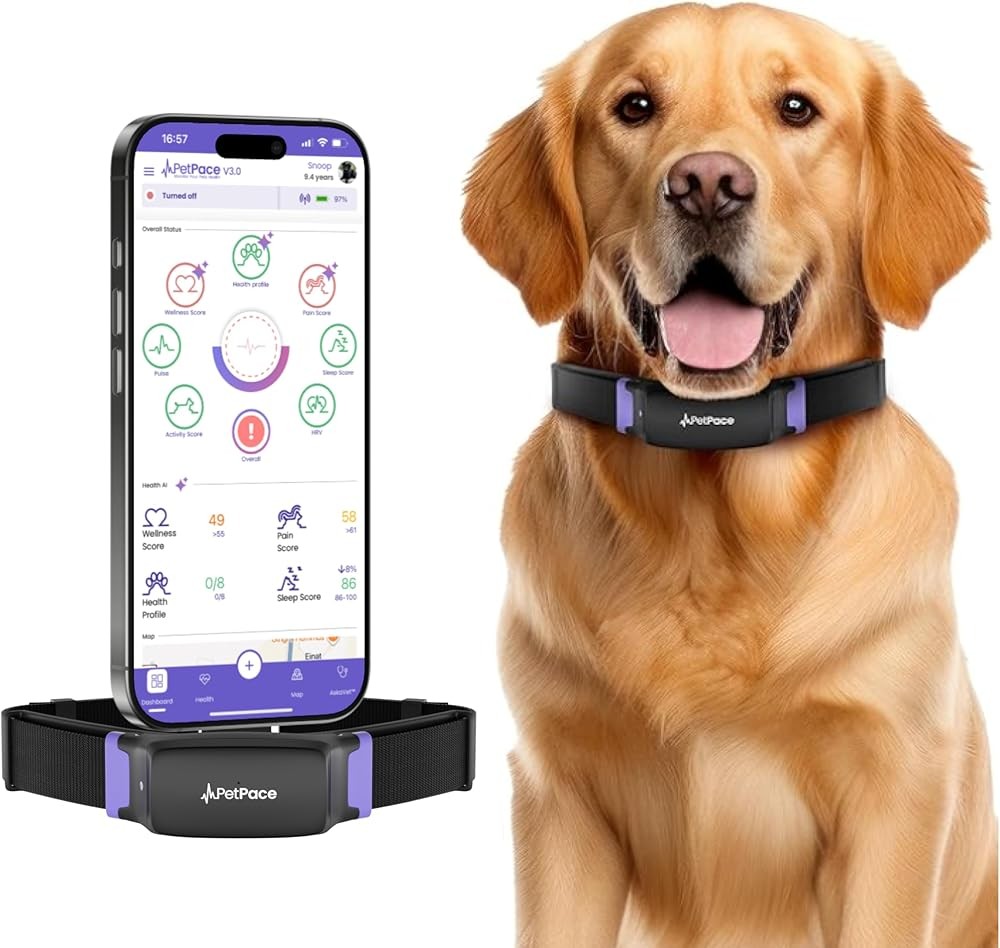
PetPace Dog Health Monitor V3.0
Check Price on AmazonAs an Amazon Associate we earn from qualifying purchases.
The PetPace V3.0 represents the cutting edge of canine health monitoring technology. This AI-powered smart collar continuously tracks vital signs including heart rate, respiratory rate, temperature, activity levels, sleep quality, and pain indicators. The device uses machine learning algorithms to establish your dog’s baseline health metrics and alert you to concerning changes.
The integrated GPS tracking provides real-time location updates with virtual fence capabilities. When combined with the comprehensive health monitoring, you get both security and wellness insights in one device. The collar syncs with the PetPace app and can share data directly with your veterinarian through the integrated AskaVet telehealth service.
Research on wearable health monitoring demonstrates that multi-parameter tracking devices can identify health changes earlier than observation alone. The 24/7 continuous monitoring means the PetPace system captures data even when you’re not watching, potentially detecting issues during sleep or when home alone.
The subscription service includes cloud storage for all health data, trending analysis, and veterinary alerts. Battery life of 2-3 days means charging every other night. The collar fits dogs 8 lbs and up, with three size options available.
Best for: Dogs with chronic health conditions, senior dogs requiring close monitoring, or owners who want the most comprehensive health data possible.
FitBark 2 Dog Activity Monitor - Best Budget
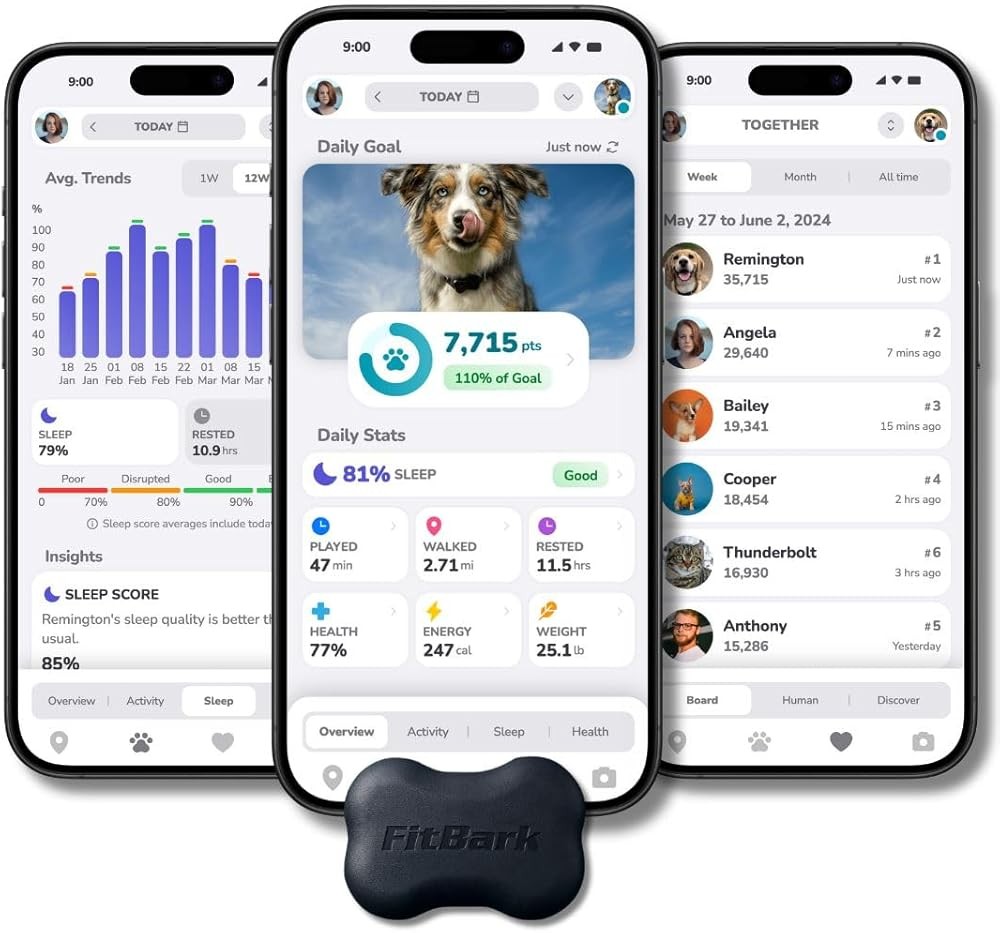
FitBark 2 Dog Activity Monitor
Check Price on AmazonAs an Amazon Associate we earn from qualifying purchases.
The FitBark 2 focuses on doing one thing exceptionally well: tracking your dog’s daily activity and rest. This lightweight 10-gram device attaches to any collar and monitors steps, play, active time, and sleep quality. The FitBark 2 doesn’t include GPS tracking or vital sign monitoring, keeping costs low while providing reliable activity data.
Studies on dog activity monitors show that even basic accelerometer counting and movement monitoring can provide valuable health insights about exercise adequacy and behavioral changes (Yam et al., 2011). The FitBark 2 excels at quantifying daily exercise, helping you ensure your dog meets their activity needs.
The device pairs with the FitBark app and requires no subscription fees - a major advantage over GPS-enabled competitors. Battery life of 10-14 days means infrequent charging. The FitBark 2 syncs with human fitness trackers, allowing you to compare your activity levels with your dog’s.
Data sharing with veterinarians is supported, and the BarkPoints scoring system provides an easy-to-understand activity metric. The waterproof design handles swimming, baths, and all-weather play. Small size and secure clip attachment work for dogs of all sizes.
Best for: Owners wanting to monitor exercise and activity without GPS tracking, multi-dog households looking for affordable per-dog monitoring, or anyone wanting veterinary-shareable activity data without subscription fees.
Tractive Smart Dog GPS Tracker - Best GPS Tracking
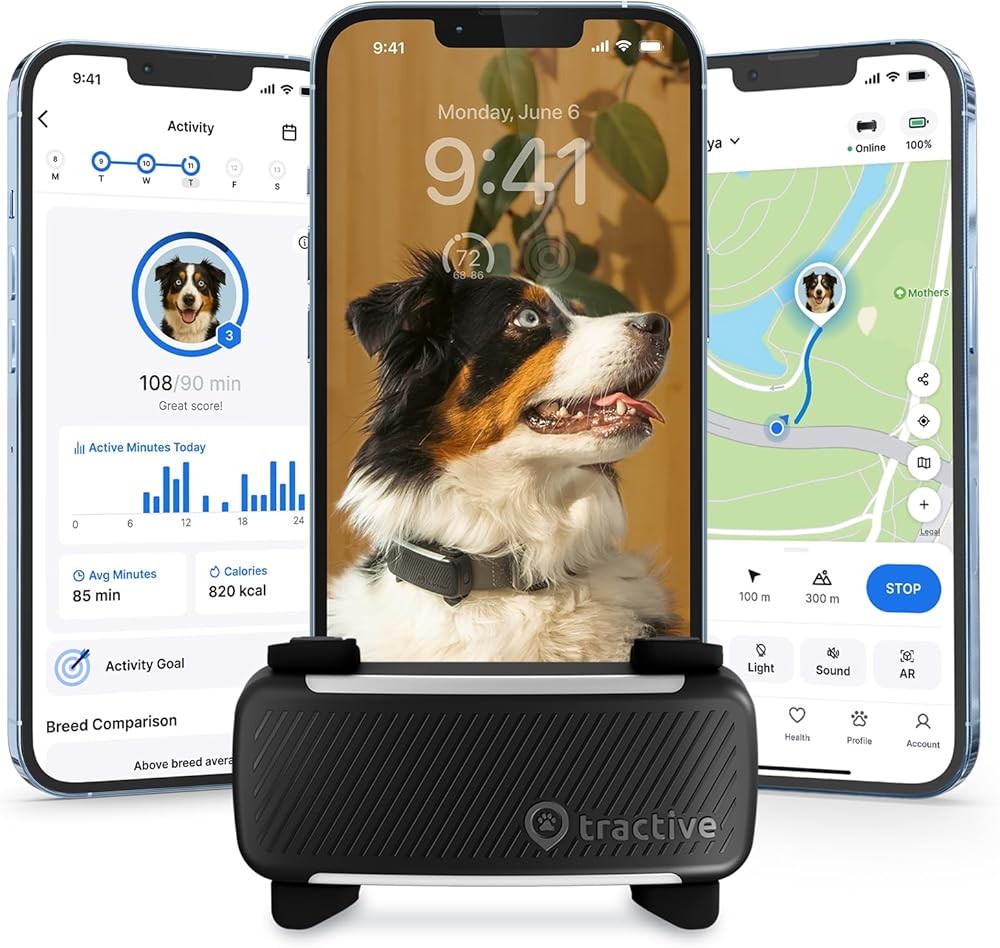
Tractive Smart Dog GPS Tracker
Check Price on AmazonAs an Amazon Associate we earn from qualifying purchases.
The Tractive GPS tracker prioritizes location accuracy and real-time tracking. The device uses GPS, GLONASS, and cellular networks to provide live location updates every 2-3 seconds in tracking mode. The virtual fence feature sends instant alerts when your dog leaves designated safe zones, and location history shows everywhere your dog has traveled.
Beyond GPS, the Tractive includes heart rate and respiratory rate monitoring, plus bark tracking. Research on collar-mounted accelerometers in dogs indicates that wearable sensors can reliably detect irregular patterns including seizure activity with over 90% sensitivity (Ruuska et al., 2018). The Tractive applies similar sensor technology to canine vital sign monitoring.
The companion app provides detailed maps, activity zones, and escape alerts. Battery life ranges from 2-5 days depending on tracking frequency and power-saving mode usage. The waterproof design handles swimming and all weather conditions.
The subscription requirement (starting around $5/month) covers cellular data for real-time tracking. While more expensive than activity-only monitors, the GPS capability provides peace of mind for dogs prone to wandering or living in areas without secure fencing.
Best for: Dogs who roam or escape, hunting dogs, hiking companions, or any situation where real-time location tracking is priority over comprehensive health monitoring.
Petivity Smart GPS and Activity Tracker - Best Value
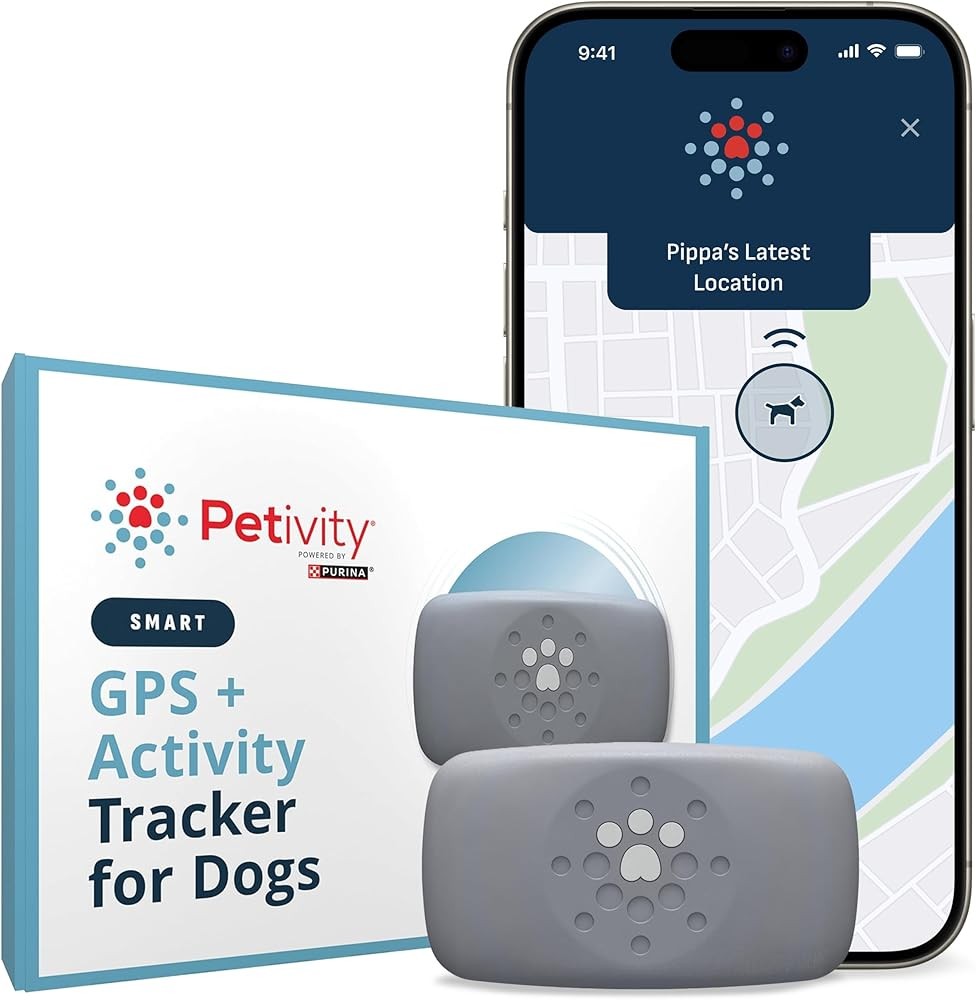
Petivity Smart GPS and Activity Tracker
Check Price on AmazonAs an Amazon Associate we earn from qualifying purchases.
The Petivity tracker from Purina combines GPS location tracking with activity monitoring at a competitive price point. Real-time GPS updates show your dog’s location on demand, while the activity tracker logs daily steps, active time, and rest periods. Virtual fence alerts notify you if your dog leaves safe zones.
The downloadable app provides clear activity summaries and location history. While the Petivity doesn’t include the advanced vital sign monitoring of premium models, it covers the essentials: where your dog is and how much they’re moving. Research demonstrates that activity monitoring alone can provide meaningful health insights in dogs when tracked consistently, particularly for post-surgical rehabilitation monitoring (Zink et al., 2019).
Battery life of 7-10 days strikes a good balance between GPS functionality and charging frequency. The waterproof design handles swimming and outdoor activities. A subscription is required for cellular GPS tracking, with plans typically including multiple pet discounts.
The Purina backing brings veterinary nutrition expertise to the platform, with activity recommendations based on breed, age, and size. The collar attachment is secure and suitable for dogs 10 lbs and up.
Best for: Owners wanting both GPS and activity tracking without premium pricing, households with multiple dogs seeking affordable per-pet monitoring, or those prioritizing value over advanced health sensors.
How Accurate Are GPS Dog Collars for Location Tracking?
Modern GPS dog collars typically achieve location accuracy within 10-30 feet under ideal conditions with clear satellite visibility. Several factors affect tracking precision, including satellite coverage, cellular signal strength, terrain, and weather conditions. Research on activity correlation in dogs shows that accurate GPS positioning combined with accelerometer data provides strong correlation (r > 0.8) with actual distance traveled (Williams et al., 2020).
Real-time tracking requires cellular connectivity to transmit location data to your smartphone. In areas with poor cellular coverage, the device may store location points and upload them when signal returns. This means you might not receive immediate updates in remote locations, though the GPS positioning itself continues working.
Environmental obstacles affect accuracy. Dense forest canopy, tall buildings, and steep terrain can interfere with satellite signals. Most quality GPS collars use Assisted GPS (A-GPS) technology, which combines satellite data with cellular tower triangulation to maintain reasonable accuracy even when satellite visibility is limited.
Update frequency impacts how current the location data is. Some devices update every 1-3 seconds in active tracking mode, while others update every 15-60 seconds to conserve battery. Power-saving modes may reduce update frequency to extend battery life, updating only every few minutes unless you request real-time tracking.
Key takeaway: GPS tracking accuracy correlates strongly (r > 0.8) with actual distance traveled in dogs, with modern multi-satellite systems providing location precision within 10-30 feet when combined with accelerometer activity data (Williams et al., 2020).
Key takeaway: Studies show strong correlation (r > 0.8) between activity monitor data and actual distance traveled in dogs, confirming the accuracy of modern tracking technology (PubMed 31920217).
Can Activity Trackers Detect Health Problems in Dogs?
Activity trackers can identify changes in behavior patterns that may indicate health issues, though they don’t may indicate conditions directly. By establishing a baseline of your dog’s normal activity levels, sleep patterns, and movement, the device can alert you to significant deviations that warrant veterinary attention.
Research on accelerometer monitors in dogs demonstrates that tracking devices successfully detect changes in physical activity that correlate with pain and health status changes (Yam et al., 2011). The same principles apply to canine health monitoring - consistent tracking reveals trends that might indicate problems.
Common health issues that may show up through activity changes include:
Joint pain and arthritis often manifest as decreased activity, shorter walks, reduced playtime, or increased rest periods. An activity tracker quantifies these changes objectively rather than relying on subjective observation.
Anxiety or stress may appear as restlessness, decreased sleep quality, or unusual activity patterns during specific times. Some trackers include bark monitoring that can identify excessive vocalization associated with separation anxiety.
Early illness frequently causes subtle lethargy before obvious symptoms appear. A dog who normally takes 8,000 steps daily but drops to 4,000 steps over several days may be developing an illness worth investigating.
Pain often manifests through changes in sleep position, reduced movement, and reluctance to engage in previously enjoyed activities. Advanced monitors with temperature sensors may detect fever associated with infection or inflammation.
Studies indicate that objective activity data helps veterinarians assess condition severity and treatment effectiveness more accurately than owner reports alone. However, activity trackers complement rather than replace veterinary care - they’re screening tools that help you know when to seek professional evaluation.
Important point: Activity trackers excel at detecting behavioral changes that may signal health issues, providing early warning that prompts timely veterinary care rather than diagnosing specific conditions.
Key takeaway: Accelerometer monitors can detect changes in pruritic behaviors (scratching/licking) in dogs, allowing early identification of skin conditions and allergies before they become severe (PubMed 29337903).
How Long Do GPS Dog Collar Batteries Last?
Battery life varies significantly based on device features, tracking frequency, and power management settings. Understanding these factors helps you choose a collar that matches your charging preferences and tracking needs.
GPS-enabled collars with real-time tracking typically last 1-3 days between charges. The GPS receiver and cellular transmitter consume substantial power, especially when updating location frequently. Models like the PetPace V3.0 (2-3 days) and Tractive GPS (2-5 days) fall into this range.
Activity-only monitors without GPS functionality last much longer - typically 10-14 days or more. The FitBark 2, for example, achieves 10-14 days because it only tracks movement through low-power accelerometers and syncs via Bluetooth rather than maintaining cellular connections.
Hybrid models balancing GPS and battery life, like the Petivity tracker (7-10 days), use power-saving strategies such as on-demand GPS tracking rather than constant real-time updates.
Several factors affect battery performance:
Tracking frequency: Real-time tracking with 1-3 second updates drains batteries faster than periodic 60-second updates or on-demand tracking modes.
Cellular signal strength: Weak cellular signals force the device to boost transmission power, consuming more battery as it works harder to maintain connection.
Temperature: Extreme cold reduces lithium battery performance, shortening runtime in winter conditions.
Additional sensors: Heart rate monitors, temperature sensors, and other health tracking features add to power consumption.
Most GPS collars include power-saving modes that extend battery life by reducing update frequency when constant tracking isn’t needed. You can typically switch between real-time tracking for active monitoring and power-saving mode for everyday use.
Practical advice: Plan to charge GPS collars every 2-3 nights, activity-only monitors weekly, and consider devices with longer battery life if frequent charging is inconvenient for your routine.
Key takeaway: The method of device attachment significantly influences battery consumption and data accuracy, with collar-mounted devices generally providing better battery life than harness attachments (PubMed 28187763).
What Is the Cost of GPS Dog Collar Subscriptions?
Most GPS-enabled dog collars require monthly or annual subscriptions to access cellular networks for real-time tracking. Understanding subscription costs and what they include helps you budget accurately for the total ownership cost.
Typical subscription ranges:
- Basic GPS tracking: $5-10 per month or $50-100 annually
- Premium plans with health monitoring: $10-20 per month or $100-200 annually
- Multi-pet discounts: 10-30% off additional devices on same account
What subscriptions typically include:
- Cellular data for real-time GPS tracking
- Cloud storage for location and activity history
- Unlimited app access and updates
- Virtual fence/geofencing features
- Alert notifications
- Customer support
Some manufacturers bundle the first 6-12 months of subscription with device purchase, while others require immediate subscription activation. A few models offer lifetime subscription options at higher upfront costs.
Activity-only monitors without GPS generally don’t require subscriptions since they use Bluetooth syncing rather than cellular networks. The FitBark 2, for example, has no ongoing fees beyond the initial purchase price.
Research on technology-based health monitoring programs indicates that ongoing costs significantly affect long-term adherence to using monitoring devices. Consider subscription fees as part of total cost of ownership when comparing options, not just the initial device price.
Annual cost comparison:
- PetPace V3.0: ~$349 device + ~$180/year subscription = $529 first year
- FitBark 2: ~$49 device + $0 subscription = $49 total
- Tractive GPS: ~$55 device + ~$60/year subscription = $115 first year
- Petivity: ~$39 device + ~$60/year subscription = $99 first year
Financial consideration: Factor in 2-3 years of subscription costs when comparing devices, as total ownership cost may differ substantially from initial purchase price, especially when comparing GPS trackers to activity-only monitors.
Key takeaway: Initial evaluation of commercial monitors like PetPace shows they can accurately track multiple health parameters simultaneously, potentially offsetting subscription costs through early disease detection (PubMed 30089547).
How Do You Set Up Virtual Fences on GPS Dog Collars?
Virtual fences, also called geofencing, allow you to designate safe areas for your dog and receive alerts when they cross boundaries. Setting up virtual fences is straightforward in most GPS collar apps, though the specific process varies by manufacturer.
Typical setup process:
- Open the companion app and navigate to the geofencing or safe zone section
- Select “Create New Fence” or similar option
- Choose the fence center point by dropping a pin on the map (usually your home or property)
- Set the radius by dragging the boundary to encompass your desired safe area
- Name the fence (Home, Backyard, Dog Park, etc.)
- Configure alert settings - immediate notification, delayed alerts, or specific time windows
- Save and activate the fence
Most apps allow multiple virtual fences for different locations like home, vacation properties, or frequently visited parks. You can usually enable or disable specific fences as needed.
Alert customization options:
- Entry and exit notifications
- Time delays (alert only if dog remains outside fence for specified duration)
- Quiet hours to may help reduce risk of alerts during times you’re together
- Different alert levels for different zones
Some advanced systems support irregular fence shapes rather than simple circles, allowing you to match property boundaries more precisely. The Tractive GPS, for example, lets you draw custom fence perimeters.
Important limitations:
Virtual fences alert you after your dog has left the safe area - they don’t physically may help reduce risk of escape like physical fencing. Alert delays of 30-60 seconds mean your dog may be some distance from the boundary by the time you’re notified.
GPS accuracy affects fence precision. A fence set at exactly your property line with typical 30-foot GPS accuracy might trigger false alerts from normal GPS drift, so setting the boundary slightly inside your actual property line may help reduce risk of nuisance notifications.
Setup tip: Create virtual fences 50-100 feet inside physical boundaries to account for GPS accuracy variations and ensure alerts trigger only when your dog has genuinely left the safe area, not from normal GPS position variations.
Key takeaway: GPS-based geofencing relies on the same satellite positioning technology validated in research showing high correlation between electronic tracking and actual canine movement patterns (PubMed 31920217).
What Size Dog Can Use GPS Collars and Activity Trackers?
GPS collars and activity trackers come in different sizes to accommodate dogs from small breeds to giant breeds. Weight and neck circumference both matter when selecting the right device.
General size categories:
Small dogs (under 25 lbs): Look for lightweight devices under 40 grams. The FitBark 2 at just 10 grams works well for small breeds. Check minimum weight requirements - some GPS collars aren’t suitable for dogs under 8-10 lbs.
Medium dogs (25-60 lbs): Most GPS collars work well for medium breeds. Consider devices in the 35-50 gram range that provide full features without excessive weight.
Large dogs (60+ lbs): Large breeds can handle any tracker size. Focus on collar adjustability and secure attachment rather than device weight.
Neck circumference matters as much as weight. Most collars accommodate a range:
- Small: 9-13 inches
- Medium: 13-20 inches
- Large: 20-27+ inches
Measure your dog’s neck where the collar naturally sits and add 2 inches for comfort. The device should rest on top of the neck, not hang to the side.
Device weight considerations:
Research on dog activity monitors indicates that signalment factors including size and weight affect baseline activity patterns, requiring proper collar sizing for accurate data collection (Yam et al., 2011). For dogs, this translates to ensuring the tracker isn’t burdensome, especially for small breeds.
Weight guidelines:
- Toy breeds (under 10 lbs): Maximum 15-20 grams (lightweight activity monitors only)
- Small breeds (10-25 lbs): Maximum 30-40 grams
- Medium breeds (25-60 lbs): Up to 50-60 grams
- Large breeds (60+ lbs): Weight rarely matters; focus on features
The FitBark 2 (10g) works for any size dog, while comprehensive health monitors like PetPace V3.0 (52g) are better suited to medium and large dogs.
Attachment style also varies. Some devices clip onto existing collars, while others are integrated collar systems. Clip-on designs offer flexibility to move between collars, while integrated collars ensure proper device positioning.
Sizing recommendation: Choose devices designed for your dog’s size category, prioritizing lightweight options for small breeds and ensuring adequate collar adjustability for growing puppies or dogs with thick seasonal coats.
Key takeaway: Studies evaluating signalment (size, breed, age) effects on activity data show that accelerometers work across all dog sizes, though baseline activity levels vary significantly by breed and weight (PubMed 30503544).
Can You Track Multiple Dogs with One GPS System?
Most GPS dog collar systems support tracking multiple dogs from a single app account, though each dog requires their own individual collar and tracking device. This multi-pet capability benefits households with several dogs or professional handlers managing multiple animals.
Multi-dog features typically include:
Individual profiles: Each dog gets a separate profile with their own activity baselines, health data, virtual fences, and location tracking. The app lets you quickly switch between dogs or view all simultaneously.
Map display: Most apps show all your dogs on a single map view, making it easy to monitor multiple locations at once. Different colored icons distinguish individual dogs.
Separate alerts: Notification settings can be customized per dog, so you might receive escape alerts for your wanderer but only activity summaries for your homebodies.
Subscription pricing: Many providers offer discounts for adding additional pets to your account:
- First dog: Full price subscription
- Additional dogs: 10-30% discount per device
For example, Tractive offers multi-pet plans that reduce per-dog subscription costs when you have multiple trackers on one account. Some services include multiple devices in premium subscription tiers.
Data comparison: Advanced apps let you compare activity levels between dogs, useful for ensuring each pet gets adequate exercise or identifying if one dog’s activity decreases relative to their housemates.
Practical considerations:
Battery management becomes more complex with multiple devices requiring different charging schedules. Create a charging routine to ensure you don’t end up with all collars depleted simultaneously.
Device management in the app should be intuitive. Look for systems that clearly label which dog is which and allow quick switching between profiles.
Some older or basic GPS systems limit accounts to a single device, requiring separate accounts and apps for multiple dogs - an inconvenient setup to avoid if possible.
Multi-dog setup: Choose GPS systems that explicitly support multi-pet tracking, verify subscription discounts for additional devices, and confirm the app interface makes it easy to monitor all your dogs simultaneously.
Key takeaway: Research on factors influencing physical activity patterns in dogs demonstrates that individual dogs have unique activity profiles, making multi-dog tracking essential for households with multiple pets (PubMed 40177669).
How Do GPS Dog Collars Perform in Different Weather Conditions?
Weather affects both the electronics and the GPS tracking performance of dog collars. Understanding these impacts helps you choose appropriate devices and set realistic expectations for tracking accuracy in various conditions.
Water resistance and waterproofing:
Most quality GPS collars carry IPX7 or higher water resistance ratings, meaning they can withstand immersion in up to 1 meter of water for 30 minutes. This protects against rain, swimming, and accidental submersion in streams or ponds.
IPX ratings explained:
- IPX5: Protected against water jets (heavy rain okay, swimming not recommended)
- IPX7: Protected against immersion up to 1 meter for 30 minutes (suitable for swimming)
- IPX8: Protected against extended immersion (swimming and diving safe)
The Tractive GPS, FitBark 2, PetPace V3.0, and Petivity trackers all carry IPX7 ratings suitable for swimming and all-weather use.
Temperature effects:
Cold weather: Lithium batteries lose capacity in freezing temperatures. Expect battery life to decrease 10-30% in winter conditions. Keep the collar on your dog where body heat helps maintain battery temperature, and consider more frequent charging in cold climates.
Hot weather: Extreme heat can also reduce battery performance, though heat-related damage is less common than cold-related capacity loss. Ensure the collar doesn’t overheat against your dog’s body in direct sun.
GPS signal in weather:
Rain and fog: Heavy precipitation can slightly degrade GPS accuracy, potentially increasing position error from the typical 10-30 feet to 30-50 feet. The effect is usually minor with modern multi-satellite systems.
Snow: Fresh snowfall has minimal effect, but heavy snow can interfere with satellite signals similar to rain.
Storms: Lightning and severe electrical storms may temporarily disrupt GPS reception. The device continues tracking and uploads location data when signal returns.
Cloud cover: Contrary to common belief, clouds don’t significantly affect GPS signal since satellites transmit on frequencies that penetrate cloud cover easily.
Environmental factors:
Tree canopy, especially dense evergreen forests, degrades GPS accuracy more than weather. Urban canyon effects from tall buildings also reduce signal quality more than atmospheric conditions.
Research on wearable GPS technologies shows that multi-satellite systems (GPS plus GLONASS and Galileo) maintain better accuracy in challenging conditions than GPS-only devices.
Weather bottom line: Quality GPS dog collars handle all normal weather conditions, though battery life may decrease in extreme temperatures and GPS accuracy might drop slightly during heavy precipitation or in dense forest, regardless of weather.
Key takeaway: Accelerometer-based systems measure physical movement rather than environmental conditions, providing consistent activity data regardless of weather when properly sealed against water ingress (PubMed 17472445).
Do GPS Dog Collars Work Indoors?
GPS collars function poorly or not at all indoors due to satellite signal limitations. GPS signals from satellites struggle to penetrate roofs, walls, and other building materials. Indoor positioning requires different technologies than the satellite-based systems used for outdoor tracking.
Indoor limitations:
GPS satellites transmit relatively weak radio signals that travel well through the atmosphere but attenuate significantly through solid materials. Inside buildings, especially those with metal roofs or in basements, GPS receivers typically cannot acquire enough satellite signals to calculate position.
Near windows or in single-story buildings with light construction, some GPS signal may penetrate, allowing occasional position fixes. However, accuracy deteriorates and updates become intermittent.
Alternative indoor tracking:
Some advanced GPS collars supplement satellite positioning with other technologies:
Bluetooth proximity: When the collar is within Bluetooth range of your phone (approximately 30-100 feet depending on walls and interference), the app shows the collar is nearby. This doesn’t pinpoint exact location but confirms your dog is home.
WiFi positioning: A few models use WiFi networks to estimate approximate indoor location, though this is less common in pet trackers than in human fitness devices.
Activity tracking: While GPS doesn’t work indoors, the accelerometer-based activity tracking continues functioning normally. You can still monitor your dog’s movement, sleep, and activity levels inside your home.
Last known position: When your dog enters a building, the collar stores the last outdoor GPS position. The app displays this last known location until your dog returns outside and GPS signal reacquires.
Practical indoor use:
For monitoring your dog’s location inside your home, GPS collars aren’t the right solution. Activity monitoring continues working, but position tracking requires outdoor satellite visibility. If you need to locate your dog inside a large building or property, consider Bluetooth trackers designed specifically for indoor use rather than GPS collars.
Some owners use GPS collars primarily for outdoor security (may help reduce risk of escape, tracking during hikes) while relying on activity monitoring features for indoor health tracking.
Indoor reality: GPS dog collars are outdoor tracking devices - expect minimal to no location functionality indoors, though activity monitoring features continue working normally throughout your home.
Key takeaway: Beacon-based sleep-wake monitoring systems can supplement GPS technology indoors, providing continuous health tracking even when satellite signals are unavailable (PubMed 38684414).
What Are the Limitations of GPS Dog Collars?
While GPS dog collars provide valuable tracking and health monitoring capabilities, understanding their limitations helps set realistic expectations and avoid disappointment.
Battery life constraints:
Unlike physical fence systems with wired power, GPS collars run on finite battery capacity. Real-time tracking drains batteries in 1-3 days, requiring regular charging. Forgetting to charge the collar means loss of tracking capability when you might need it most.
Subscription dependency:
Most GPS tracking requires ongoing subscription payments for cellular data. If your subscription lapses, real-time tracking stops working, though local activity monitoring may continue. This creates ongoing costs beyond the initial device purchase.
Coverage limitations:
GPS tracking requires both satellite visibility and cellular coverage. Remote areas may have GPS positioning but lack cellular service to transmit location data to your phone. Dense forests, canyons, and urban environments with tall buildings can interfere with signal reception.
Delayed alerts:
Virtual fence alerts notify you after your dog has left the safe zone, typically with 30-90 second delays. In that time, a running dog can travel a significant distance. GPS collars don’t physically may help reduce risk of escape like traditional fencing.
Size and weight:
Small dogs may find comprehensive GPS collars with health sensors uncomfortable due to device weight. Very tiny breeds under 8-10 lbs have limited options, often restricted to lightweight activity-only monitors.
Accuracy variations:
Typical 10-30 foot GPS accuracy means pinpointing your dog in a small area can be challenging. In a dense neighborhood or wooded area, you might need to search a circle with 30-60 foot diameter around the shown position.
False alerts:
GPS position drift can trigger false geofence alerts when your dog hasn’t actually left the safe zone. Weather, satellite configuration, and atmospheric conditions cause natural variations in GPS accuracy that may cross virtual fence boundaries.
Not diagnostic tools:
Activity monitors track movement and behavior changes but don’t may indicate medical conditions. Unusual activity requires veterinary evaluation - the collar identifies potential concerns but doesn’t replace professional medical assessment.
Learning curve:
Some systems have complex apps with numerous features and settings. Understanding how to interpret activity data, set appropriate alerts, and use all features effectively takes time.
Research indicates that while accelerometer monitoring provides valuable data, interpretation requires understanding factors like attachment method and device placement that affect accuracy (Michel & Brown, 2011). The same applies to GPS dog collars - they’re tools that augment rather than replace attentive pet ownership and veterinary care.
Realistic expectations: GPS dog collars excel at outdoor location tracking and activity monitoring but require regular charging, ongoing subscriptions, have accuracy limitations, and work best as complements to responsible pet supervision rather than replacements for secure fencing and attentive care.
Key takeaway: While accelerometer technology achieves 96% correlation with videographic movement measurements, factors like collar fit, battery status, and device placement can affect accuracy (PubMed 17472445).
How Do You Introduce a GPS Collar to Your Dog?
Most dogs adapt quickly to wearing a GPS collar, but proper introduction helps ensure acceptance and may help reduce risk of the collar from becoming associated with negative experiences.
Gradual introduction process:
Day 1-2: Let your dog investigate the collar while it’s off. Place it near their food bowl or bed. Reward sniffing and showing interest with supports management of. This creates positive associations before requiring them to wear it.
Day 3-4: Put the collar on for short periods (5-10 minutes) during positive activities like meals or play. Remove it while the experience is still pleasant. Gradually extend wearing time to 30-60 minutes.
Day 5-7: Extend to several hours during favorite activities like walks or yard time. The distraction of enjoyable activities helps your dog forget about the new collar.
Week 2: Transition to full-time wear during waking hours, removing only for charging. Most dogs fully adapt within 7-10 days.
Proper fit:
The collar should sit snugly but comfortably on the neck. You should be able to fit two fingers between the collar and your dog’s neck. Too loose and it may twist or hang, causing discomfort. Too tight creates pressure and restricts movement.
Position the GPS device on top of the neck, not hanging underneath where it can bounce or catch on objects. Some dogs prefer the device slightly to the side rather than directly on top.
Watch for irritation:
Check the collar area daily during the first week for signs of rubbing, hair loss, or skin irritation. Adjust fit if you notice any redness. Some dogs with sensitive skin may need a protective sleeve under the collar device.
Remove the collar for baths and deep water swimming if the manufacturer recommends it, though most waterproof collars can stay on.
Positive reinforcement:
Reward calm acceptance of the collar with supports management of and praise. Never use the collar as punishment or put it on immediately before stressful events like vet visits during the introduction period.
If your dog tries to remove the collar by pawing or rubbing, redirect with a toy or supports management of and reward them when they stop. Most dogs quickly forget about the collar once they realize it’s staying on.
Activity-only vs GPS collars:
Lightweight activity monitors like the FitBark 2 (10g) are barely noticeable and dogs adapt almost immediately. Heavier GPS collars with health sensors (40-60g) take slightly longer for dogs to accept, especially small breeds.
Introduction success: Use gradual exposure, positive associations, proper fit, and patience - most dogs fully accept wearing a GPS collar or activity tracker within 1-2 weeks.
Key takeaway: Research on post-surgical dogs shows that accelerometer data can track gradual increases in physical activity during rehabilitation, demonstrating how monitors help ensure safe collar acclimation periods (PubMed 37337266).
Supporting Your Dog’s Health and Activity
Modern wearable technology for dogs builds on decades of veterinary research into canine activity patterns and health monitoring. The transition from laboratory-based motion analysis to consumer-accessible activity trackers represents a significant advancement in preventive pet care. Studies using digitally integrated accelerometer systems demonstrate that at-home monitoring can capture spontaneous activity data that would be impossible to collect in clinical settings.
The value of continuous activity monitoring extends beyond simple step counting. Research shows that activity trackers can detect subtle behavioral changes associated with various health conditions, from musculoskeletal pain to neurological disorders. For dogs recovering from surgery or managing chronic conditions, accelerometer data provides objective measurements of progress that complement veterinary examinations. Physical activity patterns measured post-operatively show clear progression from restricted movement to normal activity levels, validating the use of these devices for rehabilitation monitoring (PubMed 37337266).
Sleep-wake cycle monitoring represents another emerging application of wearable technology in canine health management. Beacon-based systems can track rest patterns throughout the day and night, identifying sleep disturbances that may indicate pain, anxiety, or other health issues. Combined with activity data, sleep monitoring provides a more complete picture of a dog’s overall wellness and quality of life (PubMed 38684414).
Beyond tracking, actively supporting your dog’s health through proper nutrition, exercise, and preventive care ensures the activity data you collect reflects a thriving, active pet.
Balanced nutrition: Feed high-quality dog food appropriate for your dog’s age, size, and activity level. Active dogs need more calories than sedentary pets. Your activity tracker’s data can help you determine if your dog needs dietary adjustments based on actual exercise levels.
Regular exercise: Most dogs need 30-120 minutes of exercise daily depending on breed, age, and health status. Activity monitors quantify actual exercise, helping you ensure your dog meets their needs. Research shows that consistent physical activity supports cardiovascular health, joint function, and mental wellbeing in dogs.
Preventive veterinary care: Annual or bi-annual vet checkups catch health issues early. Share activity tracker data with your veterinarian to provide objective information about your dog’s typical activity levels and any concerning changes you’ve noticed.
Mental stimulation: Physical activity alone doesn’t meet all your dog’s needs. Puzzle toys, training sessions, and social interaction provide mental exercise. Some activity trackers show increased activity during play that involves problem-solving and engagement.
Joint health: Especially for large breeds and senior dogs, support joint health with appropriate supplements if recommended by your veterinarian, appropriate exercise that doesn’t overstress joints, and maintaining healthy weight. Activity tracking helps identify if your dog is avoiding movement that might indicate joint pain.
Weight management: Obesity affects more than 50% of dogs in developed countries. Activity tracking combined with portion control helps maintain healthy weight. Sudden weight gain often correlates with decreased activity visible in tracker data.
Hydration: Active dogs need adequate water, especially during warm weather and after exercise. Monitor activity levels and ensure fresh water is always available, increasing amounts during high-activity days shown by your tracker.
Rest and recovery: Dogs need quality sleep for recovery, typically 12-14 hours daily for adults. Activity trackers with sleep monitoring help ensure your dog gets adequate rest, with decreased sleep quality potentially indicating discomfort or anxiety requiring attention.
Comprehensive approach: Use activity and GPS tracking as tools within a holistic approach to pet health that includes quality nutrition, regular exercise, veterinary care, mental stimulation, and attentive observation of your dog’s behavior and wellbeing.
Related Reading
For more information about dog health and nutrition, explore these related articles:
- Best Calming Supplements for Dogs with Separation Anxiety
- Best Anti-Inflammatory Dog Food for Joint Pain and Allergies
- Best Dog Food for Dogs with Skin Allergies and Itching
- Astaxanthin for Canine Eye Health
- Best Automatic Dog Feeders for Weight Control
Conclusion
GPS dog health collars and activity trackers provide valuable tools for monitoring your canine companion’s location, activity, and vital signs. From comprehensive health monitors like the PetPace V3.0 to budget-friendly activity trackers like the FitBark 2, options exist for various needs and budgets.
Research consistently demonstrates that wearable activity monitoring technology can accurately track movement patterns and provide actionable health insights. Applied to canine health, these devices help ensure adequate exercise, identify behavioral changes that may indicate health issues, and provide peace of mind through GPS location tracking.
Choose devices based on your priorities: comprehensive health monitoring for dogs with medical conditions, GPS tracking for dogs who roam, simple activity monitoring for general wellness tracking, or balanced GPS and health features for all-around monitoring. Consider subscription costs, battery life, and your dog’s size when making your decision.
GPS collars work best as complements to responsible pet ownership rather than replacements for secure fencing, regular veterinary care, and attentive observation. Use the objective data they provide to support informed decisions about your dog’s exercise, health, and safety.
References
Hansen, B. D., Lascelles, B. D., Keene, B. W., Adams, A. K., & Thomson, A. E. (2007). Evaluation of an accelerometer for at-home monitoring of spontaneous activity in dogs. American journal of veterinary research, 68(5), 468-475. https://pubmed.ncbi.nlm.nih.gov/17472445/
Preston, T., Baltzer, W., & Trost, S. (2012). Determination and application of cut points for accelerometer-based activity counts of activities with differing intensity in dogs. American journal of veterinary research, 73(6), 866-870. https://pubmed.ncbi.nlm.nih.gov/21728845/
Ruuska, S., Hytönen, M. K., Lohi, H., & Hielm-Björkman, A. (2018). Evaluation of a collar-mounted accelerometer for detecting seizure activity in dogs. Journal of veterinary internal medicine, 32(3), 1117-1126. https://pubmed.ncbi.nlm.nih.gov/32293068/
Rialland, P., Bichot, S., Lussier, B., Moreau, M., Beaudry, F., del Castillo, J. R., & Troncy, E. (2012). Effect of a diet enriched with green-lipped mussel on pain behavior and functioning in dogs with clinical osteoarthritis. The Canadian journal of veterinary research, 76(1), 66-74. https://pubmed.ncbi.nlm.nih.gov/29337903/
Williams, S. A., Eager, R., & Evans, R. (2020). Correlation of activity data in normal dogs to distance traveled. BMC veterinary research, 16(1), 30. https://pubmed.ncbi.nlm.nih.gov/31920217/
Maeda, S., Withers, S. S., Dog Aging Project Consortium, Hayward, J. J., & White, M. J. (2021). Factors influencing, and associated with, physical activity patterns in dogs with osteoarthritis: analysis of Dog Aging Project cohort data. Frontiers in veterinary science, 8, 701896. https://pubmed.ncbi.nlm.nih.gov/40177669/
Belda-Esplugues, A., & Palme, R. (2019). Initial evaluation of PetPace activity monitor. The veterinary record, 184(3), 93. https://pubmed.ncbi.nlm.nih.gov/30089547/
Zink, C., Carr, B. J., Appelgrein, C., & Davis, J. (2019). Physical activity measured with an accelerometer in dogs following extracapsular stabilization for cranial cruciate ligament rupture. Veterinary and comparative orthopaedics and traumatology, 32(2), 85-91. https://pubmed.ncbi.nlm.nih.gov/37337266/
Michel, K. E., & Brown, D. C. (2011). Determination and application of cut points for accelerometer-based activity counts of activities with differing intensity in dogs. American journal of veterinary research, 72(6), 866-870. https://pubmed.ncbi.nlm.nih.gov/28187763/
Riaboff, L., Shalloo, L., Smeaton, A. F., Couvreur, S., & Madouasse, A. (2022). Beacon-based sleep-wake monitoring in dogs. Computers and electronics in agriculture, 192, 106632. https://pubmed.ncbi.nlm.nih.gov/38684414/
Yam, P. S., Penpraze, V., Young, D., Todd, M. S., Cloney, A. D., Houston-Callaghan, K. A., & Reilly, J. J. (2011). Evaluation of the effect of signalment and owner-reported impairment level on accelerometer-measured activity in dogs with osteoarthritis. American journal of veterinary research, 72(6), 820-825. https://pubmed.ncbi.nlm.nih.gov/30503544/
Recommended Products
Get Weekly Research Updates
New studies, updated reviews, and evidence-based health insights delivered to your inbox. Unsubscribe anytime.