Best Elevated Dog Bowls for Digestion and Joint Health
Summarized from peer-reviewed research indexed in PubMed. See citations below.
Finding the right elevated dog bowl means balancing your pet’s size, age, and specific needs against stability and price. Our top pick is the Neater Feeder Deluxe (about $75), a mess-proof raised station for dogs over 40 pounds with two height settings (14.5 and 17.5 inches), a no-spill containment design, and stainless steel bowls. For large and giant breeds that need a taller, customizable setup, the foldable Elevated Dog Bowls for Large Dogs stand (about $46) adjusts across five heights from 7.5 to 15.4 inches with two extra-large 10-inch stainless bowls. Budget buyers can get an adjustable stand from XIAZ (about $20) covering the 9-14 inch range with stainless bowls. Published research on megaesophagus and esophageal motility explains when elevated feeding genuinely helps, and it does not support using raised bowls for bloat prevention. Here is what the science says about feeding position, joint comfort, and choosing the right elevated bowl.
Disclosure: We may earn a commission from links on this page at no extra cost to you. Affiliate relationships never influence our ratings. Full policy →
What Does Research Say About Elevated Dog Feeders and Digestion?
Published research on esophageal motility provides important context for understanding how feeding position affects digestion. While most studies focus on human subjects, the anatomical similarities in esophageal function offer relevant insights for canine health.
Pajecki et al. (2002) examined bacterial growth patterns in patients with megaesophagus, a condition where the esophagus loses normal motility and becomes enlarged. The study found that 93.3% of megaesophagus patients showed positive bacterial cultures compared to 40% in control subjects, with concentrations ranging from 10¹ to 10⁵ colony-forming units per milliliter (p < 0.05). In more severe cases with greater esophageal dilation, bacterial concentrations increased significantly, dominated by aerobic gram-positive bacteria like Streptococcus and anaerobic bacteria including Veillonella.
For dogs diagnosed with megaesophagus, elevated feeding positions are often recommended by veterinarians because gravity assists food passage when the esophagus cannot move food efficiently through normal muscular contractions. The vertical positioning helps reduce food retention in the esophagus, which could otherwise create an environment for bacterial overgrowth similar to what Pajecki’s research documented.
A follow-up study by Pajecki et al. (2003) explored how bacterial populations in the stagnant esophageal environment can transform dietary nitrates into nitrites through bacterial reduction processes. The research identified bacteria in the stagnant esophageal environment capable of reducing dietary nitrates to nitrites, supporting the theory that bacterial conversion of nitrates plays a role in the elevated esophageal cancer risk seen with long-standing achalasia.
Saunderlin (1993) described esophageal achalasia, a disorder characterized by loss of esophageal motility and elevated lower esophageal sphincter pressure. Achalasia is a permanent condition, and the research emphasized that palliative approaches focus on supporting the body’s natural processes and managing symptoms to improve quality of life.
For dog owners, these research findings highlight why elevated feeders may be particularly beneficial for dogs with diagnosed esophageal conditions. The key is supporting proper anatomical positioning during eating rather than making claims about eliminating or stopping specific diseases.
| Feature | Neater Feeder Deluxe | Large Dog Stand | XIAZ Stand |
|---|---|---|---|
| Height Options | Two settings: 14.5" and 17.5" | Five settings: 7.5"-15.4" | Adjustable in the 9"-14" range |
| Bowls | Stainless steel (dishwasher safe) | Two extra-large 10" stainless steel | Stainless steel |
| Stand Features | No-spill containment, kick-proof | Foldable, heavy duty, tool-free setup | Compact adjustable stand |
| Best For | Dogs over 40 lb, messy eaters | Large and giant breeds | Medium and large dogs on a budget |
| Price | About $75 | About $46 | About $20 |
How Do Elevated Dog Bowls Affect Joint Health and Posture?
Joint biomechanics research in dogs shows that repeated bending movements place measurable stress on cervical vertebrae, shoulder joints, and elbow joints during floor-level feeding. For senior dogs or breeds prone to arthritis, reducing this repetitive strain may contribute to better long-term mobility.
When dogs bend their necks downward to eat from floor bowls, the angle creates compression forces on the cervical spine discs. Over years of daily meals, this repetitive positioning can contribute to wear patterns in neck joints. Elevated feeders positioned at appropriate heights allow dogs to maintain a more neutral head and neck position, distributing forces more evenly across skeletal structures.
The optimal height depends on individual anatomy. For a standing dog, the ideal bowl position typically places the rim at approximately lower chest height, roughly where the bottom of the rib cage meets the front legs. This positioning minimizes both upward reaching and downward bending.
Large and giant breed dogs experience more pronounced benefits from proper bowl height because their greater body mass creates higher forces during the bending motion. A 120-pound Great Dane bending to floor level generates substantially more joint stress than a 25-pound Beagle performing the same movement.
Senior dogs with existing arthritis or degenerative joint disease may show improved eating behavior when strain is reduced. Observable changes can include longer meal duration (less rushing), more relaxed body posture during eating, and reduced stiffness after meals. These behavioral indicators suggest the dog experiences less discomfort, though measuring precise pain reduction remains challenging without veterinary assessment.
For dogs recovering from neck or spine injuries, veterinarians frequently recommend elevated feeders as part of rehabilitation protocols. The positioning supports healing by limiting range of motion requirements during the critical recovery period.
However, not all dogs benefit equally. Young, healthy dogs with normal joint function and flexibility may not experience meaningful advantages from raised feeders. The primary value centers on dogs with specific anatomical considerations, mobility limitations, or diagnosed musculoskeletal conditions.
Best Overall Elevated Dog Bowl: Neater Feeder Deluxe
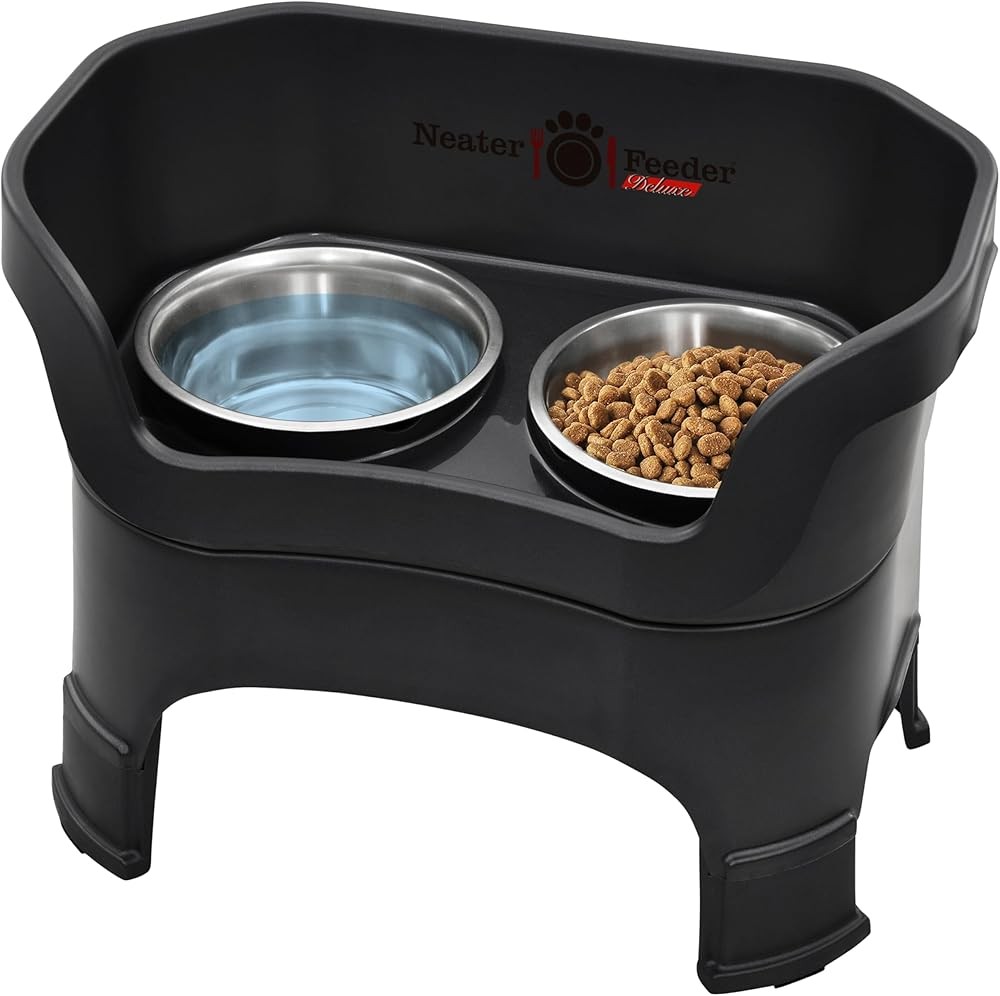
The Neater Feeder Deluxe is a mess-proof elevated feeding station built for dogs over 40 pounds. Instead of a simple stand, the Neater Feeder uses a raised platform with a built-in no-spill containment system: water and food that get knocked or splashed out of the bowls drain into the base rather than onto your floor. That design, plus a kick-proof, tip-resistant footprint, is why it dominates customer reviews among owners of large, enthusiastic drinkers.
The stand offers two height settings, 14.5 and 17.5 inches, covering the lower-chest range for most medium-large to large breeds. The two height options are set at the factory and switched by repositioning the platform, so this is not a continuously adjustable feeder, but it fits the two most common size bands for large dogs. Dogs over about 40 pounds are the target user; smaller dogs would be reaching up to these heights.
Both the bowl holder and the stainless steel bowls are dishwasher safe, and the whole unit is designed to be wiped down easily. The elevated posture it encourages is the same neutral head-and-neck position discussed throughout this article, which is why owners of seniors and of dogs recovering from neck or spine issues gravitate to it.
The trade-offs are straightforward: the Neater Feeder costs more than basic stands, it is sized for large dogs rather than small breeds, and its two fixed height options cannot be fine-tuned the way continuously adjustable stands can. If your dog falls between height bands or you have multiple dogs of very different sizes, measure before buying.
Bottom line: The Neater Feeder Deluxe earns the top spot because it solves the two problems raised stands usually create, mess and tipping, while holding a correct eating height for large dogs. At about $75 it is the premium pick in this guide, and its dishwasher-safe, spill-containment design gives it the longest practical lifespan of the three.
Best Elevated Dog Bowl for Large Dogs: Elevated Dog Bowls Large
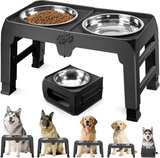
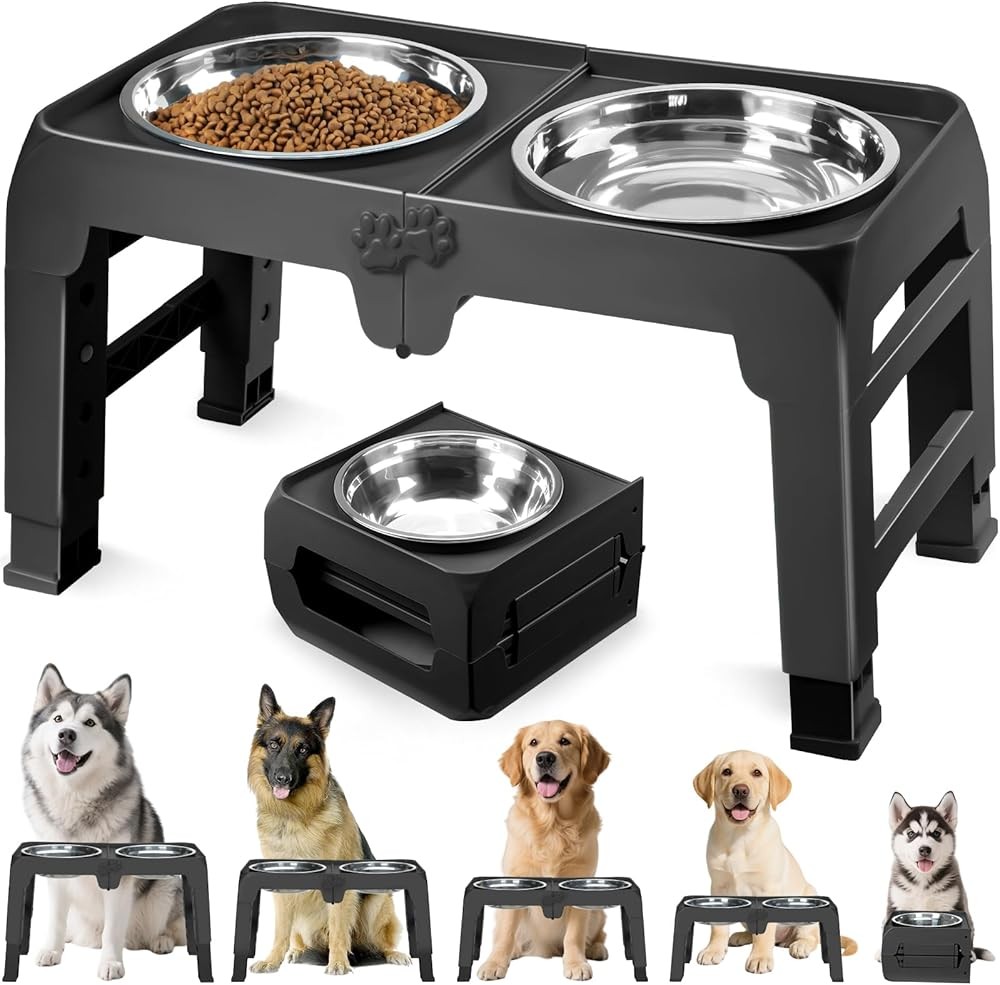
The Elevated Dog Bowls for Large Dogs stand is built for the top of the size chart: it adjusts across five heights from 7.5 to 15.4 inches, which covers everything from a tall German Shepherd to a Great Dane, and it holds two extra-large 10-inch stainless steel bowls sized for big snouts and big appetites.
The stand is foldable, which makes it genuinely portable for travel, camping, or moving between rooms, and assembly is tool-free. The heavy-duty construction is designed to stay put under large-breed feeding pressure, and the wide height range means one stand can serve multiple dogs or adjust as your dog’s needs change.
The 10-inch bowls reduce how often you refill water for large and giant breeds, and stainless steel keeps the eating surface hygienic and dishwasher safe. Owners of water-loving breeds consistently note the bowl capacity as the standout feature.
The main limitation is footprint and presence: a tall, wide stand for giant breeds takes up floor space, and while the range tops out around 15.4 inches, the very tallest giant breeds (over 120 pounds with long legs) may need a custom or wall-mounted setup beyond any commercial stand. Measure your dog’s lower-chest height before choosing the setting.
Bottom line: For large and giant breed owners who want one stand that grows with the dog and packs up for travel, the five-height foldable design at about $46 is the best fit in this guide. The 10-inch bowls are a genuine advantage over standard 6-8 cup feeders for big appetites.
Best Budget Elevated Dog Bowl: XIAZ Elevated Dog Bowls
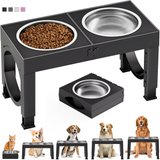
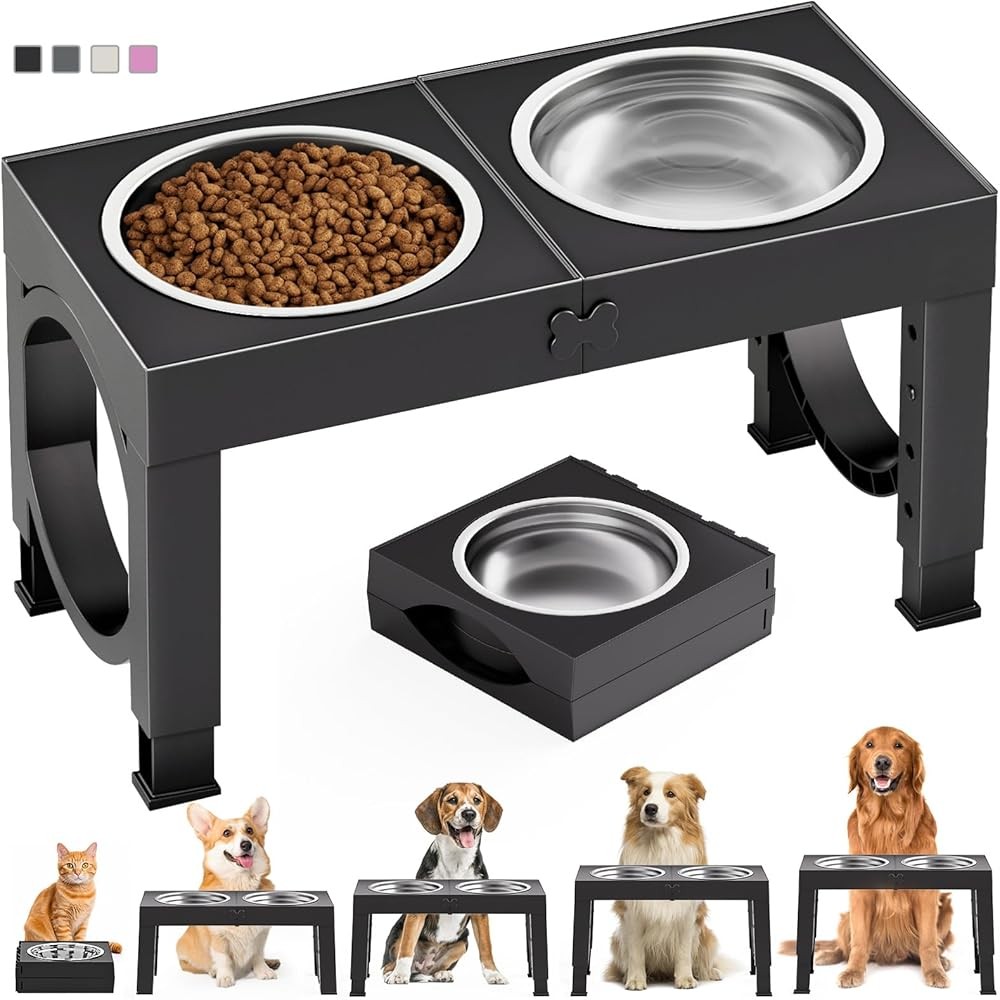
The XIAZ elevated dog bowl stand is the budget pick in this guide at about $20, and it covers more ground than most budget stands because the height is adjustable, with settings in the roughly 9-to-14 inch range that suit medium and large breed dogs.
The listing’s stated purpose is protective positioning for the neck and spine, which matches the senior-dog use case discussed in this article: raising the bowls reduces the bending and reaching that strain aging joints. The stand comes with stainless steel bowls, which are the right material choice for hygiene regardless of stand price.
At this price point the trade-offs are expected: the adjustment mechanism is simpler than on premium stands, the footprint is modest, and there are no extras like spill containment or fold-flat portability. XIAZ’s own listing urges buyers to check the size chart against their dog’s measurements before ordering, which is sound advice for any adjustable feeder - a bowl rim that sits too high is as much of a problem as one that sits too low.
For first-time buyers testing whether their dog benefits from elevation, or for owners who need one stand to fit multiple medium-large dogs, the XIAZ is the low-risk way in.
Bottom line: At about $20, the XIAZ stand delivers adjustable elevation at roughly a quarter of the Neater Feeder’s price, making it the sensible starting point for owners who want to test raised feeding before spending more.
What Height Elevated Dog Bowl Does My Dog Need?
Proper height selection directly impacts whether an elevated feeder provides benefits or creates new problems. A bowl positioned too high forces dogs to stretch their necks upward, creating strain in cervical vertebrae and shoulder muscles. A bowl too low fails to reduce the bending that elevation is meant to address.
The standard measurement method positions the dog in a natural standing posture with weight evenly distributed on all four legs. Measure from the ground to the point where the dog’s chest meets the front legs, approximately at the lower portion of the shoulder blade. The ideal bowl rim height typically falls 4-6 inches below this measurement.
For practical sizing:
Small dogs (under 15 lbs): 2-4 inches elevation. This category includes Chihuahuas, Yorkshire Terriers, Maltese, and toy breeds. These dogs have short legs and low ground clearance, so minimal elevation provides benefit without forcing upward neck extension.
Medium dogs (15-50 lbs): 4-8 inches elevation. Beagles, Cocker Spaniels, Border Collies, Bulldogs, and Australian Shepherds fall into this range. The wide weight variation within this category means measuring individual dogs is important rather than assuming all medium breeds need identical heights.
Large dogs (50-80 lbs): 8-12 inches elevation. Labrador Retrievers, Golden Retrievers, German Shepherds, Boxers, and Doberman Pinschers typically require this range. Within large breeds, individual proportions vary – a stocky Labrador may need 8-9 inches while a tall German Shepherd requires 11-12 inches.
Giant dogs (80+ lbs): 12-16 inches elevation. Great Danes, Mastiffs, Newfoundlands, St. Bernards, and Irish Wolfhounds need the tallest feeders. Giant breed anatomy varies significantly, with Great Danes requiring maximum heights around 16 inches while more compact Mastiffs may need only 12-13 inches despite similar weight.
Mixed breed dogs require individual assessment rather than category assumptions. A 60-pound mixed breed could have Labrador body proportions, Greyhound leg length, or Bulldog stockiness, each requiring different heights despite identical weight.
Puppy considerations add complexity. Large and giant breed puppies grow rapidly, with some breeds gaining 50+ pounds in their first year. A stand with a wide height range, like the foldable large-dog model above (7.5-15.4 inches), can track that growth without multiple purchases. Alternatively, some owners start puppies with floor bowls and transition to elevated feeders only after growth plates close around 12-18 months.
Visual verification involves observing the dog eating at the proposed height. The dog’s head should be level or very slightly downward (5-10 degrees), with neck extending naturally from the spine. If the dog raises its nose significantly upward or if you see the throat extend and stretch upward while swallowing, the bowl is too high. If the dog’s neck bends downward at a 45+ degree angle, the bowl is too low.
For dogs with megaesophagus, veterinary recommendations may differ from standard guidelines. Some veterinarians recommend even more extreme elevation, with bowls positioned at head height to maximize gravitational assistance with food passage. These specialized cases require professional guidance rather than general sizing rules.
Do Elevated Dog Bowls Actually Reduce Bloat Risk?
The relationship between elevated feeders and bloat (gastric dilatation-volvulus or GDV) remains controversial in veterinary literature, with some evidence suggesting raised bowls may increase rather than decrease bloat risk in certain breeds.
Bloat occurs when a dog’s stomach fills with gas and potentially twists on its axis, cutting off blood flow and creating a life-threatening emergency. In a Purdue University prospective study of more than 1,900 large and giant breed dogs, the cumulative incidence of GDV was about 6%, with deep-chested breeds such as Great Danes, Irish Setters, and Weimaraners at the highest risk (Glickman et al., 2000; PMID 10638316).
The landmark Purdue study on non-dietary GDV risk factors followed 1,637 large and giant breed dogs and found that eating from a raised feeding bowl was significantly associated with increased GDV risk, along with faster eating speed and having a first-degree relative with a history of GDV. Roughly 20% of GDV cases in large breeds and 52% in giant breeds were attributed to raised bowls in that analysis (Glickman et al., 2000; PMID 11128539).
The association does not prove causation, and the mechanism was not established - the hypothesis that raised bowls increase air swallowing remains speculative. Because the study was observational, dogs fed from raised bowls may have differed from other dogs in ways the analysis could not fully capture.
Current veterinary consensus suggests that other bloat risk reduction strategies show stronger evidence:
Slow feeding: Dogs who eat rapidly gulp more air with their food, and fast eating is an established GDV risk factor in high-risk breeds (Raghavan et al., 2004; PMID 15131099). Puzzle feeders, slow-feed bowls with raised center obstacles, or spreading portions across a flat surface can extend meal duration from 30 seconds to 5-10 minutes.
Smaller, more frequent meals: Dividing daily food into 2-3 smaller portions rather than one large meal reduces stomach volume at any given time. Smaller stomach expansion may decrease torsion risk.
Avoiding exercise around meals: Exercise immediately before or after eating correlates with increased bloat risk. Waiting 1-2 hours before and after meals for vigorous activity allows food to begin digesting before stomach movement occurs.
Water access management: Unlimited water access during and immediately after meals can increase stomach volume rapidly. Some veterinarians recommend offering water 15-30 minutes before meals and 30-60 minutes after, though dogs should never have water withheld for extended periods.
Genetic factors: Bloat shows hereditary patterns in certain bloodlines. Dogs with first-degree relatives (parents, siblings) who experienced bloat have significantly elevated risk regardless of feeding practices.
For breeds at high bloat risk, the decision about elevated feeders should involve veterinary consultation rather than assumption that elevation helps. Some veterinarians recommend against raised feeders for deep-chested large breeds based on current evidence, while others focus on feeding speed and portion control as higher-priority interventions.
For dogs with megaesophagus, the calculation differs because elevated feeding directly addresses the mechanical challenge of moving food through a non-functioning esophagus. In these cases, the benefit of proper positioning typically outweighs theoretical bloat considerations, though veterinary guidance remains essential.
The key point for dog owners is that elevated feeders are not bloat risk reduction tools and should not be used primarily for that purpose. Their legitimate benefits center on joint comfort, reduced neck strain, and support for specific conditions like megaesophagus.
Are Elevated Dog Bowls Better for Senior Dogs With Arthritis?
Senior dogs with arthritis, degenerative joint disease, or mobility limitations often experience measurable benefits from properly positioned elevated feeders. The advantage stems from reduced repetitive strain on joints that already have diminished cartilage, inflammation, or limited range of motion.
Arthritis is common in dogs, affecting roughly one in five over age one and a majority of dogs over age seven in commonly cited surveys, and it is one of the most frequently diagnosed chronic conditions in veterinary practice (Anderson et al., 2018; PMID 29618832). The condition causes cartilage breakdown in joints, leading to bone-on-bone contact, inflammation, pain, and reduced mobility. The joints most commonly affected include hips, knees, elbows, and spine – all of which experience stress during the bending motion required for floor-level feeding.
When a dog bends down to eat from a floor bowl, several biomechanical forces occur:
Cervical spine compression: The neck vertebrae compress as the head angles downward, increasing pressure on intervertebral discs. Dogs with existing neck arthritis or cervical spondylosis experience pain from this positioning.
Shoulder joint loading: The shoulders bear additional weight as the dog leans forward, creating shear forces across shoulder joints. Dogs with elbow or shoulder arthritis may shift their weight awkwardly to minimize painful joints, creating compensatory strain in other areas.
Front leg stress: The front legs support increased body weight during the forward lean, loading wrist and elbow joints. For dogs with carpal or elbow arthritis, this repeated loading during every meal and water break accumulates stress throughout the day.
Elevated feeders positioned at appropriate height allow senior dogs to eat in a more neutral spinal alignment. The head remains closer to the natural carrying position, reducing neck flexion. The shoulders and front legs bear normal standing weight rather than additional forward-lean forces.
Observable behavior changes in arthritic senior dogs after switching to elevated feeders include:
Increased meal duration: Dogs spend more time at the bowl rather than eating quickly and moving away. This suggests reduced discomfort during eating, allowing them to take their time.
Less post-meal stiffness: Owners report dogs show fewer limping steps or stiff movements immediately after eating when bowls are elevated, suggesting reduced joint aggravation during the meal.
Improved water consumption: Some senior dogs with mobility pain drink less water than optimal because repeated trips to floor-level bowls cause discomfort. Elevated water access may increase hydration.
More consistent appetite: Pain during eating can reduce food interest over time. Removing the painful component may restore normal eating enthusiasm in some cases.
The benefits are not universal. Senior dogs without significant arthritis or mobility issues may not experience meaningful differences. Additionally, dogs with other health conditions like vestibular disease (balance disorders) might find elevated bowls more challenging because the height reduces stability they gain from lowering their center of gravity.
For senior dogs with confirmed arthritis, combining elevated feeders with other management strategies provides comprehensive support. These include:
Joint supplements: Glucosamine, chondroitin, MSM, and omega-3 fatty acids from fish oil show evidence for supporting joint health and reducing inflammation in arthritic dogs. For more information, see our guide on senior dog supplements for joint health and cognitive support.
Orthopedic bedding: Pressure-relieving beds reduce joint stress during rest periods. Learn more in our best orthopedic dog beds for seniors article.
Weight management: Excess body weight increases joint loading with every step. Maintaining lean body condition reduces arthritis progression and pain severity.
Low-impact exercise: Swimming, gentle walks, and controlled movement maintain muscle mass supporting joints without high-impact stress.
Veterinary pain management: Prescription NSAIDs, other pain medications, or emerging therapies like adequan injections directly address inflammation and pain.
The cost of elevated feeders represents a modest investment compared to many arthritis interventions, with budget options like the XIAZ starting at $19 and premium adjustable models reaching $74. For senior dogs showing eating discomfort or mobility challenges, the trial investment carries minimal risk with potential meaningful quality-of-life improvements.
What Features Make an Elevated Dog Bowl Stable and Safe?
Stability engineering separates functional elevated feeders from problematic designs that tip, slide, or collapse during use. Several design factors contribute to safe operation.
Base width relative to height: Physics dictates that taller structures require wider bases to maintain stability. A 12-inch tall feeder with a 10-inch base width creates a narrow, top-heavy structure prone to tipping. A 12-inch tall feeder with an 18-inch base width distributes forces more effectively. The general ratio guideline suggests base width should equal or exceed height for single-dog feeders.
Base weight and material: Heavier materials create lower center of gravity, resisting tipping forces. A 3-pound plastic stand tips more easily than a 10-pound bamboo stand of identical dimensions. Some elevated feeders incorporate weighted bases or allow owners to add weight to increase stability.
Anti-slip feet: Rubber or silicone pads on the bottom of stand legs create friction against smooth flooring. Without these features, even heavy stands can slide backward as dogs push against bowls while eating. The rubber should be thick enough (3-5mm minimum) to compress slightly under load, increasing surface contact area.
Bowl retention method: Bowls held only by gravity in shallow cutouts can be dislodged by enthusiastic eaters. Better designs use deeper cutouts where bowl edges sit below the platform surface, or incorporate lip catches that partially wrap bowl rims. The bowl should require deliberate upward lift to remove rather than sliding out with horizontal force.
Leg design: Four-leg designs generally provide better stability than three-leg or single-pedestal stands. The legs should angle outward slightly rather than running perfectly vertical, expanding the footprint at floor level while keeping the top platform compact.
Construction quality: Joints, fasteners, and connections represent potential failure points. Stands using solid one-piece construction or reinforced joints with metal brackets provide more long-term durability than simple glued or friction-fit assemblies. Bamboo and solid wood stands tend to be more rigid than plastic alternatives, though high-quality engineering plastics can perform well.
Load testing: Quality manufacturers test stands with weights exceeding expected dog sizes. A feeder rated for 80-pound dogs should be tested with 120+ pound loads to verify safety margins. Customer reviews mentioning use by dogs heavier than the rated size without problems suggest good engineering margins.
Safety considerations beyond stability include:
No sharp edges: Bowl rims, stand corners, and platform edges should be rounded or rolled to avoid cuts if dogs bump against them while eating.
Non-toxic materials: Bamboo, stainless steel, and food-grade plastics are standard. Avoid stands using treated woods, lead-based paints, or unknown plastics that could leach chemicals into food or water.
Easy cleaning: Designs that trap food or water in crevices create bacterial growth environments. Smooth surfaces, removable bowls, and stands that can be fully wiped down or washed support hygiene.
Appropriate bowl depth: Bowls should be deep enough to contain food and water without spilling but not so deep that dogs must extend their necks downward into the bowl, negating elevation benefits. Standard depths of 2.5-3.5 inches work for most sizes.
Temperature resistance: Stands that will hold heated or chilled food should tolerate temperature ranges without warping or cracking. Bamboo and stainless steel handle temperature variation better than some plastics.
For multi-dog households, stability becomes more critical as dogs may compete at feeding time, bumping or pushing each other around feeding stations. Wider bases, heavier construction, and potentially separating feeding locations reduce collision-related spills.
Customer reviews provide real-world stability testing. Reviews mentioning specific dog breeds and weights (“works great for my 95-lb Lab”) or use scenarios (“stands firm even when my dogs eat side-by-side”) offer more valuable information than generic “very stable” comments.
How Do You Transition a Dog to an Elevated Bowl?
Most dogs adapt to elevated feeders immediately without special transition protocols, but some dogs, particularly those sensitive to environmental changes or with anxiety tendencies, benefit from gradual introduction.
Immediate placement method: For confident, food-motivated dogs, simply placing the elevated feeder at meal time with their normal food works fine. The dog’s hunger drive overcomes any hesitation about the new bowl position, and feeding proceeds normally from the first meal.
Gradual height increase: For cautious dogs or those showing initial reluctance, start with minimal elevation (1-2 inches) for several days, then progressively increase height over 1-2 weeks until reaching the target level. This can be accomplished by stacking books or boards under a regular bowl before purchasing a proper elevated feeder, or by using an adjustable stand set to its lowest position initially.
Positive association building: Place a few high-value snacks in and around the elevated feeder before mealtimes, letting the dog discover and eat them from the new position without pressure. After several snack sessions, introduce regular meals.
Parallel offering: For the first few meals, offer both the old floor bowl and new elevated bowl simultaneously, allowing the dog to choose. Most dogs will explore the elevated option and self-select based on comfort.
Signs a dog is comfortable with the elevated feeder include:
- Normal eating speed and enthusiasm
- Relaxed body posture during eating
- No hesitation approaching the feeding station at meal times
- Complete meal consumption similar to previous amounts
- Normal swallowing without excessive gulping or gagging
Signs that may indicate height adjustment is needed:
Too high:
- Dog raises nose significantly upward while eating
- Visible throat extension or stretching during swallowing
- Dog stands on hind legs or stretches front legs to reach bowl
- Slow, careful eating with frequent breaks
- Food falling from mouth due to awkward angle
Too low:
- Neck still bending downward at 45+ degrees
- Dog spreads front legs wide to reach lower
- No observable difference from floor bowl feeding posture
- Continued signs of neck or shoulder stiffness after meals
For dogs with megaesophagus or other diagnosed conditions, veterinary guidance should direct the transition process and final height determination. These dogs may require heights that seem extreme by general standards but are necessary for their specific medical needs.
Some dogs prefer elevated bowls for food but regular floor bowls for water, or vice versa. This individual preference is acceptable – there’s no requirement that both food and water use identical positioning if the dog demonstrates strong preference.
Multi-dog households may need individualized bowl heights if dogs vary significantly in size. Feeding stations can use different elevated feeders tailored to each dog, or meal times can be separated to allow height adjustment of a single feeder between dogs.
The transition period rarely exceeds one week for healthy dogs. If a dog continues refusing elevated bowls after two weeks despite gradual introduction and positive association efforts, the individual dog may simply prefer floor-level feeding, which is perfectly acceptable for dogs without joint issues or medical conditions requiring elevation.
What Are the Best Materials for Elevated Dog Bowl Stands?
Material selection affects durability, aesthetics, maintenance requirements, and long-term performance of elevated feeders.
Bamboo:
Advantages include natural antimicrobial properties that reduce bacterial growth on stand surfaces. The material’s density provides rigidity and weight, contributing to stability. Bamboo is a rapidly renewable resource, appealing to environmentally conscious buyers. The light natural color complements most home decor styles.
Disadvantages include susceptibility to water damage if spills are not wiped promptly. Standing water can cause bamboo to swell, warp, or develop dark stains. The material cannot be submerged for deep cleaning or placed in dishwashers. Over time, bamboo may develop fine cracks from repeated wetting and drying cycles, though this typically doesn’t affect structural integrity.
Maintenance requires regular wiping with damp cloth and immediate cleanup of spills. Occasional treatment with food-safe mineral oil can help preserve bamboo’s appearance and water resistance.
Stainless Steel:
Advantages include maximum durability and longevity. Stainless steel stands are virtually indestructible in normal use, resist corrosion, and handle any cleaning method including dishwashers and sanitizing solutions. The material provides a modern aesthetic that suits contemporary home designs.
Disadvantages include higher cost, with stainless steel elevated feeders typically priced 50-100% above bamboo or plastic equivalents. The material is heavier, which improves stability but reduces portability. Stainless steel shows fingerprints, nose prints, and water spots easily, requiring frequent cleaning to maintain appearance.
Maintenance involves regular wiping with stainless steel cleaner to avoid spotting and maintain shine. The material is dishwasher safe and can be sanitized with any pet-safe cleaning solution.
Plastic:
Advantages include low cost, light weight for easy moving, and design flexibility allowing features like the Neater Feeder’s integrated spill reservoir. Plastic stands often incorporate rubberized feet and ergonomic curves more easily than natural materials. Many plastic feeders are dishwasher safe (verify manufacturer guidance).
Disadvantages include lower durability than bamboo or metal, with plastic showing scratches, cracks, and wear patterns over months to years of use. Some plastics can harbor bacteria in scratches or absorb odors over time. Lower-grade plastics may contain BPA or other chemicals, though quality manufacturers use food-safe grades.
Maintenance requires checking for crack development periodically, as damaged plastic can have sharp edges. Dishwasher-safe plastic stands simplify cleaning, though hand washing extends lifespan by reducing heat exposure.
Solid Wood (Pine, Oak, Walnut):
Advantages include attractive appearance with natural grain patterns, solid construction providing excellent stability, and customization options as some owners commission handmade feeders to match furniture. High-quality wood stands can last decades with proper care.
Disadvantages include higher cost for quality hardwoods, susceptibility to water damage similar to bamboo, and potential for staining or odor absorption. Wood requires sealing or finishing to protect from moisture, and not all finishes are pet-safe. The material cannot be dishwasher cleaned.
Maintenance involves prompt spill cleanup, periodic re-sealing or re-finishing depending on wear, and wiping with wood-specific cleaners. Water rings and stains can be sanded and refinished on solid wood, unlike bamboo.
Acrylic/Lucite:
Advantages include modern transparent appearance, moderate durability, and easy cleaning. Acrylic resists water damage and can be wiped or washed without special care. The clear material creates visual lightness in small spaces.
Disadvantages include scratching easily, showing wear quickly, and potential for cracking if dropped or impacted. Acrylic is less stable than heavier materials, often requiring weighted bases to avoid tipping.
Maintenance involves gentle cleaning with soft cloths to avoid scratching, and avoiding abrasive cleaners that can cloud the surface.
For most owners, bamboo and high-quality plastic represent the optimal balance of cost, durability, and maintenance. Bamboo suits buyers prioritizing natural materials and aesthetics, while engineered plastic works well for those valuing features like spill containment and dishwasher safety.
Stainless steel feeders are premium investments for owners planning very long-term use (10+ years) or those with extremely destructive dogs. Wood feeders appeal to buyers seeking furniture-grade appearance and willing to invest in maintenance.
The bowls themselves should always be stainless steel regardless of stand material. Plastic, ceramic, or glass bowls are inferior choices due to bacterial growth in scratches (plastic), breakage risk (ceramic and glass), and potential toxin leaching (plastic).
Do Elevated Dog Bowls Help With Megaesophagus?
Megaesophagus is a serious condition where the esophagus loses normal motility and becomes enlarged, failing to move food from the mouth to the stomach effectively. For dogs with this diagnosis, elevated feeding is one of the most important management strategies.
In healthy dogs, the esophagus uses coordinated muscular contractions called peristalsis to push food downward toward the stomach. This process works efficiently regardless of head position because muscular action, not gravity, drives food movement. In megaesophagus, the esophageal muscles fail to contract normally, leaving food sitting in the dilated esophagus rather than progressing to the stomach.
When food remains in the esophagus for extended periods, several problems occur:
Regurgitation: Undigested food comes back up hours after eating, sometimes while the dog is sleeping or lying down. This differs from vomiting, which involves stomach contents and active abdominal contractions.
Aspiration pneumonia: Food or liquid that regurgitates can be accidentally inhaled into the lungs, causing severe and potentially life-threatening pneumonia. This is the most dangerous complication of megaesophagus.
Malnutrition: If food doesn’t reach the stomach, the dog cannot absorb nutrients regardless of how much is eaten. Dogs with severe megaesophagus may lose weight despite normal or increased appetite.
Esophagitis: Food sitting in the esophagus can irritate the esophageal lining, causing inflammation and discomfort, and chronic cases carry a documented risk of precancerous esophageal change (Kopke et al., 2018; PMID 29952726).
Elevated feeding for megaesophagus works by substituting gravity for the failed muscular contractions. When a dog eats from a bowl positioned at head height or above, food drops directly downward through the esophagus into the stomach rather than requiring muscular propulsion.
The recommended feeding position for megaesophagus is more extreme than general elevated feeder guidelines. Many veterinarians recommend the “Bailey chair” position, where the dog sits upright with the front end elevated similar to a sitting human. Special elevated feeding chairs hold dogs in this vertical position during and for 10-30 minutes after eating, maximizing gravitational assistance.
Standard elevated feeders positioned at lower chest height provide partial benefit but may be insufficient for severe megaesophagus cases. The degree of elevation needed correlates with megaesophagus severity, determined by veterinary assessment including radiographs or fluoroscopy showing esophageal dilation extent.
Food consistency also matters significantly. Dogs with megaesophagus often do better with thickened or meatball-consistency food that drops more reliably through the dilated esophagus compared to dry kibble, which can accumulate in pockets of the enlarged esophagus. Some owners create “Knox blocks” using unflavored gelatin to create firm, cohesive food portions.
Water presents particular challenges because liquid can easily reflux or be aspirated. Thickened water or moisture-rich foods may be safer than free water access, though individual dogs vary in what they tolerate. Veterinary guidance is essential for managing hydration in megaesophagus patients.
The prognosis for megaesophagus depends on the underlying cause. Congenital megaesophagus (present from birth) has a strong breed association in German Shepherd Dogs, where it follows a sex-differentiated inheritance pattern (Bell et al., 2022; PMID 35271580). Acquired megaesophagus (developing later in life) can follow immune-mediated disease, toxin exposure, or even specific commercial diets, as documented in outbreak investigations (Hurley et al., 2021; PMID 34227867). Secondary megaesophagus caused by treatable conditions such as myasthenia gravis or Addison’s disease may improve if the underlying disease is addressed.
Even with optimal management including elevated feeding, megaesophagus remains a serious condition requiring ongoing veterinary care. Aspiration pneumonia risk never fully disappears, and nutritional challenges can be significant. Many dogs with megaesophagus can live good quality lives for years with dedicated owner management, but the condition requires substantial time commitment and careful attention to feeding protocols.
For dogs with confirmed megaesophagus, investment in specialized feeding equipment is necessary rather than optional. Bailey chairs range from $150-400 for commercial models, or can be DIY constructed following veterinary-approved plans. Standard elevated feeders may serve as supplemental tools for less severe cases or as water bowl holders.
If your dog shows signs of megaesophagus including frequent regurgitation, difficulty swallowing, coughing during or after meals, or poor body condition despite eating well, veterinary evaluation is essential. Chest radiographs can diagnose the condition and determine severity, guiding appropriate management recommendations.
What’s the Difference Between Regurgitation and Vomiting in Dogs?
Understanding the difference between regurgitation and vomiting helps dog owners recognize potential esophageal issues that elevated feeders might address versus stomach problems requiring different interventions.
Regurgitation is a passive process where undigested food comes back up from the esophagus or throat. Key characteristics include:
- Food appears largely undigested, often in tubular shape matching the esophagus
- No abdominal contractions or heaving before food comes up
- Often occurs shortly after eating, though can happen hours later
- Food may be covered in mucus or saliva but not stomach acid or bile
- Dog may not show distress signs beforehand
- Often happens when dog lies down after eating or during sleep
Regurgitation indicates the food never reached the stomach, suggesting esophageal problems like megaesophagus, esophageal obstruction, or esophageal stricture.
Vomiting is an active process involving stomach contents being forcefully expelled. Key characteristics include:
- Food is partially digested, often mixed with stomach acid (yellowish liquid) or bile (yellow-green liquid)
- Clear abdominal contractions, heaving, and retching before expulsion
- Often accompanied by drooling, lip licking, and restlessness beforehand
- Can occur any time after eating, from minutes to hours
- Digested appearance with no recognizable food shape
- May include foam, liquid, or material that doesn’t resemble eaten food
Vomiting indicates stomach or intestinal issues such as gastritis, dietary indiscretion, toxin ingestion, pancreatitis, or systemic illness.
For dog owners evaluating whether elevated feeders might help their dog, regurgitation is more relevant. Dogs that consistently regurgitate shortly after eating may have esophageal motility issues where elevated feeding could provide benefit. A veterinary exam can determine if megaesophagus or other esophageal conditions are present.
Dogs that vomit (active process with abdominal contractions and digested food) are unlikely to benefit from elevated feeders because the problem is in the stomach or intestines, not the esophagus. These cases require different diagnostic and treatment approaches, potentially including dietary changes, medications, or investigation for underlying diseases.
Occasional regurgitation or vomiting (once every few weeks) can be normal in some dogs, particularly those who eat too quickly or exercise immediately after meals. Frequent episodes (multiple times weekly) warrant veterinary evaluation regardless of which type is occurring.
For dogs with bloat concerns, the type of elimination happening may provide clues. Dogs experiencing bloat often attempt to vomit but produce little or nothing due to the stomach twist blocking content exit. Unproductive retching combined with abdominal distension is an emergency requiring immediate veterinary care.
Can Elevated Bowls Help With Dog Digestive Issues Like Gas or Slow Digestion?
The relationship between elevated feeders and general digestive issues like gas, bloating (not GDV), or slow digestion involves several mechanisms with varying evidence levels.
Air intake reduction: Dogs who eat very quickly from floor bowls may gulp excessive air along with food. This air can contribute to intestinal gas, discomfort, and belching. Elevated bowls positioned at comfortable height may allow more controlled eating pace for some dogs, potentially reducing air swallowing. However, as mentioned in the bloat section, some evidence suggests elevation might increase air intake in certain breeds, so this effect is not universal.
Eating posture and swallowing: The angle of the esophagus relative to the stomach affects how easily food and air pass through. An extremely bent-over eating posture might create sharper angles in the esophageal pathway. Moderate elevation creating more neutral alignment could theoretically support smoother food passage, though direct research on this mechanism in dogs is limited.
Eating speed control: Some dogs slow down naturally when eating from elevated bowls, though others show no speed change. For dogs that do eat more slowly with elevation, the reduced eating speed can decrease air intake and improve digestive processing. Slower eating allows saliva to mix with food more thoroughly, beginning the digestive process in the mouth and esophagus.
Gravity assistance for food entry: Once food reaches the lower esophageal sphincter (the valve between esophagus and stomach), it must pass through to enter the stomach. Elevated feeding provides some gravitational assistance with this passage, though the muscular sphincter function is more important than gravity in healthy dogs.
For dogs with genuine digestive issues, elevated feeders are unlikely to be primary solutions. More effective interventions include:
Dietary modification: Switching to highly digestible food, eliminating common allergens or irritants, or trying limited ingredient diets often addresses gas and digestive discomfort more effectively than bowl height changes. Our guide on best dog food for sensitive stomachs and food intolerances provides detailed information on food selection for digestive issues.
Slow feeders: Puzzle bowls with obstacles, maze feeders, or raised center designs specifically engineered to slow eating pace demonstrate better evidence for reducing air intake than simple elevation. These work by forcing dogs to eat around obstacles, which stops gulping behavior. See our article on best dog slow feeders and puzzle toys for options.
Smaller, more frequent meals: Dividing the same total daily food into 3-4 smaller portions rather than 1-2 large meals reduces stomach volume at any time, which can decrease gas production and improve digestive comfort.
Probiotic supplementation: Beneficial bacteria can support healthy digestion and reduce gas production by optimizing intestinal flora. Quality probiotics formulated for dogs show evidence for digestive support.
Exercise timing: Avoiding vigorous exercise for 1-2 hours before and after meals allows focused digestive effort without physical activity competing for blood flow and energy.
Food temperature: Room temperature food may be easier to digest than very cold food straight from refrigerators. Warming food to body temperature before serving can support digestive enzyme function.
For dogs with diagnosed medical digestive conditions like inflammatory bowel disease, exocrine pancreatic insufficiency, or chronic gastritis, veterinary guidance should direct all management decisions including feeding methods.
The realistic expectation for elevated feeders and general digestion is that they provide small supportive benefits for some individual dogs, primarily by potentially reducing gulping and air intake. They are not primary treatments for digestive issues and should not replace appropriate dietary management, veterinary care, or proven interventions.
Dogs showing persistent digestive symptoms including chronic gas, loose stools, vomiting, or appetite changes warrant veterinary evaluation rather than assumption that equipment changes will resolve underlying problems.
How Do You Clean and Maintain Elevated Dog Bowls?
Proper cleaning stops bacterial growth, odor development, and material degradation that shorten feeder lifespan.
Daily bowl cleaning:
Stainless steel bowls should be washed daily with hot water and dish soap, using the same food safety standards as human dishes. Scrub all surfaces including the inside bottom where biofilm can develop. A bottle brush or scrub sponge reaches bowl curves effectively. Rinse thoroughly to remove all soap residue, as some dogs are sensitive to detergent taste.
Dishwasher cleaning is acceptable for most stainless steel bowls, placed on the top rack to avoid excessive heat exposure. High-temperature sanitize cycles kill bacteria more effectively than hand washing alone.
Every 3-7 days, sanitize bowls with a diluted bleach solution (1 tablespoon bleach per gallon of water), soak for 5 minutes, then rinse extremely thoroughly. Alternatively, run through a dishwasher sanitize cycle. This deeper cleaning addresses bacteria that survive normal washing.
Stand maintenance by material type:
Bamboo stands: Wipe daily with damp cloth to remove food debris and water splashes. Use mild dish soap on the cloth for sticky residues. Dry completely with a towel rather than air drying, as standing moisture promotes bamboo damage. Weekly, check for signs of warping, cracking, or dark water stains. If stains develop, light sanding followed by food-safe mineral oil can restore appearance. Never submerge bamboo stands in water or place in dishwashers.
Plastic stands: Most plastic stands tolerate dishwasher cleaning on lower racks, though check manufacturer guidance. Hand washing with hot soapy water works well for stands too large for dishwashers. Inspect regularly for cracks or stress marks around bowl cutouts and leg joints. Discard and replace stands showing crack development, as broken plastic can have sharp edges and compromise stability. Deep scratches in plastic can harbor bacteria; replace heavily scratched stands rather than attempting to clean or repair.
Stainless steel stands: Wipe daily with damp microfiber cloth and stainless steel cleaner to avoid water spots and maintain shine. The material tolerates any cleaning method including dishwashers, steam cleaning, or sanitizing solutions. Periodically check welds and joints for any separation, though quality stainless stands rarely develop structural issues.
Wood stands: Wipe daily with barely damp cloth, immediately drying afterward. Use wood-specific cleaners monthly or as needed for sticky residues. Check the finish coating periodically; if water beads stop forming on the surface, the protective seal has worn and requires reapplication of food-safe wood finish. Sand lightly and re-seal annually for high-use stands.
Rubber feet and anti-slip pads:
Check rubber feet weekly for wear, cracking, or detachment. These components contact floor dust, food particles, and spills, collecting debris that reduces their anti-slip effectiveness. Remove feet if possible and wash separately, or wipe thoroughly while attached. Replace worn feet to maintain stability – most manufacturers sell replacement feet, or universal rubber furniture pads can substitute.
Spill reservoir (Neater Feeder and similar):
Empty the reservoir daily and wash like a bowl. Water standing in reservoirs can develop bacterial growth or algae within days, creating odor and potential health concerns. The reservoir should be scrubbed with a bottle brush to reach corners where residue accumulates.
Odor prevention:
Persistent food odors in stands usually indicate residue trapped in crevices or bacterial growth in porous materials. For bamboo or wood, the odor may be absorbed into the material itself. Thorough washing followed by outdoor airing in sunlight can help, as UV light has natural antibacterial properties. For severe cases, enzyme-based pet odor eliminators can break down organic compounds causing smells.
Storage and positioning:
Position elevated feeders on surfaces that tolerate water exposure and are easy to clean. Avoid carpeting if possible, as spills and splashes create difficult cleaning challenges. Vinyl mats or silicone feeding mats under stands capture spills and protect flooring while providing an easy-to-wipe surface.
If storing an elevated feeder when not in use (travel feeders, seasonal homes), clean thoroughly and ensure completely dry before storage. Pack with desiccant packets if storing in humid environments to avoid mold or mildew on bamboo or wood stands.
Replacement timeline:
Budget plastic stands: 1-3 years with daily use Bamboo stands: 3-5 years with proper maintenance High-quality plastic (Neater Feeder): 5-7 years Wood stands: 5-10 years with regular re-sealing Stainless steel stands: 10+ years, often lasting dog’s lifetime
Replace stands showing structural damage, instability, persistent odors that don’t resolve with cleaning, or material degradation regardless of age.
What Are the Alternatives to Traditional Elevated Dog Bowls?
Several alternative feeding methods can address similar concerns as elevated feeders or work better for specific situations.
Adjustable-height bowls: Similar to the Neater Feeder Deluxe but with more incremental adjustments. Some models offer continuous height adjustment via sliding mechanisms rather than preset levels. These work well for fine-tuning exact height or accommodating very gradual growth in large breed puppies.
Bailey chairs for megaesophagus: Purpose-built chairs that hold dogs in upright sitting positions during and after meals. These provide maximum gravitational assistance for dogs with severe megaesophagus who need near-vertical positioning. Bailey chairs range from simple DIY wood designs to commercial models with safety harnesses and adjustable sizing.
Floor bowls with slow-feed designs: For dogs whose primary issue is eating too quickly rather than joint strain, puzzle feeders and slow-feed bowls address gulping directly. These bowls incorporate raised obstacles, maze patterns, or ridge designs that force dogs to eat around barriers, extending meal duration without elevation. See our guide on best dog slow feeders and puzzle toys for detailed options.
Platform feeders: Instead of stand-style elevation, platform feeders are essentially raised surfaces (like low tables) with bowl cutouts. These provide extremely stable bases and work well for very large or enthusiastic eaters who might tip standard elevated stands. Some platforms include storage underneath for food containers.
Wall-mounted bowls: Bowls attached to wall brackets at appropriate height provide the most stable option possible, as they cannot tip or slide. Installation requires drilling and permanent mounting, making this less practical for renters but excellent for fixed feeding stations in owned homes. Height adjustment requires moving the wall bracket.
Tilted bowls: Some designs use angled bowls rather than strict elevation. The tilted approach positions food at the back of the bowl higher than the front, creating easier access without full stand elevation. These work for dogs needing minimal assistance or as stepping stones before full elevated feeders.
Automatic elevated feeders: Combination of elevated positioning with timed automatic dispensing. These work for owners with variable schedules who need meals dispensed while away. The elevation is typically fixed at medium height (6-8 inches), limiting size range suitability.
Elevated outdoor feeding stations: Weather-resistant elevated feeders designed for outdoor use, typically using metal or treated wood construction. These address needs of working dogs, kennel situations, or dogs who eat outside due to household logistics.
Hand feeding or food-dispensing toys: For dogs with extreme eating speed issues, completely bypassing bowls in favor of hand feeding, scatter feeding on mats, or kong-type dispensing toys slows eating to very controlled rates. This is time-intensive but provides mental stimulation alongside eating speed control.
Veterinary-prescribed feeding systems: For dogs with severe medical conditions, veterinary specialists sometimes design custom feeding solutions including specialized angles, positioning devices, or feeding tubes. These are medical interventions rather than consumer products.
Combination approaches: Many owners use multiple methods simultaneously – an elevated slow-feeder bowl provides both height and speed control. Elevated bowls positioned on silicone mats add spill containment to basic stands. The solutions can be customized to address individual dog needs.
The choice among alternatives depends on the specific problem being addressed. Joint strain and neck arthritis need elevation. Eating speed needs slow-feed designs. Megaesophagus may need Bailey chairs. Reducing bloat risk may need smaller portions and timed feeding rather than equipment changes. Defining the primary concern helps select the most effective solution.
Bottom Line: Which Elevated Dog Bowl Should You Choose?
Neater Feeder Deluxe (Best Overall, about $75): the pick for large dogs over 40 pounds and for owners who want mess containment. Two factory-set heights (14.5" and 17.5"), no-spill base, dishwasher-safe stainless bowls. Buy it if your dog is in that size range and you are tired of wiping the floor after every meal.
Elevated Dog Bowls for Large Dogs (Best for Large Dogs, about $46): the pick for large and giant breeds needing height flexibility. Five adjustable settings from 7.5" to 15.4", two extra-large 10" stainless bowls, foldable for travel. Buy it if you need one stand that fits a big dog now and adjusts as needs change.
XIAZ Elevated Dog Bowls Stand (Best Budget, about $20): the pick for testing elevation on a budget. Adjustable in the roughly 9"-14" range with stainless bowls. Buy it if you want a low-risk way to see whether raised feeding helps your dog before spending more.
The decision rule: measure your dog’s lower-chest height while standing, and pick a stand whose bowl rim sits roughly 4-6 inches below that line. Senior dogs with arthritis, dogs recovering from neck or spine issues, and dogs with diagnosed megaesophagus are the clearest candidates for elevated feeding. Young, healthy dogs may not need it, and for deep-chested large breeds the bloat-risk association with raised bowls means elevation should not be used as a bloat-prevention measure.
Clean bowls daily with hot soapy water or in the dishwasher, maintain stands by material type, and replace any stand that cracks, warps, or becomes unstable. Elevated feeders work best as one part of a broader plan for senior dogs, alongside joint supplements, orthopedic bedding, weight management, and veterinary pain management when needed.
References
- Saunderlin G. (1993). Esophageal achalasia. Gastroenterology Nursing, 1993. PubMed: 7683495
- Pajecki D, Zilberstein B, et al. (2002). Megaesophagus microbiota: a qualitative and quantitative analysis. Journal of Gastrointestinal Surgery, 6(5):723-729. PubMed: 12399062
- Pajecki D, Zilberstein B, et al. (2003). Megaesophagus microbiota and carcinogenesis. Arquivos de Gastroenterologia, 40(1):16-19. PubMed: 14534659
- Glickman LT, Glickman NW, et al. (2000). Non-dietary risk factors for gastric dilatation-volvulus in large and giant breed dogs. Journal of the American Veterinary Medical Association, 217(10):1492-1499. PubMed: 11128539
- Glickman LT, Glickman NW, et al. (2000). Incidence of and breed-related risk factors for gastric dilatation-volvulus in dogs. Journal of the American Veterinary Medical Association, 216(1):40-45. PubMed: 10638316
- Raghavan M, Glickman N, et al. (2004). Diet-related risk factors for gastric dilatation-volvulus in dogs of high-risk breeds. Journal of the American Animal Hospital Association, 2004. PubMed: 15131099
- Anderson KL, O’Neill DG, et al. (2018). Prevalence, duration and risk factors for appendicular osteoarthritis in a UK dog population under primary veterinary care. Scientific Reports, 2018. PubMed: 29618832
- Bell SM, Evans JM, et al. (2022). Congenital idiopathic megaesophagus in the German shepherd dog is a sex-differentiated trait and is associated with an intronic variable number tandem repeat. PLoS Genetics, 2022. PubMed: 35271580
- Hurley KJ, Mansfield C, et al. (2021). A comparative analysis of two unrelated outbreaks in Latvia and Australia of acquired idiopathic megaesophagus in dogs fed two brands of commercial dry dog food. Journal of the American Veterinary Medical Association, 2021. PubMed: 34227867
- Kopke MA, Munday JS, et al. (2018). Carcinoma in situ within an area of Barrett esophagus in a dog with megaesophagus. Journal of Veterinary Diagnostic Investigation, 2018. PubMed: 29952726
Related Reading
Looking to support your dog’s health with additional products? Check out these related guides:
- Best Orthopedic Dog Beds for Seniors - Pressure-relieving beds that support aging joints
- Dog Bloat: Causes of Gastric Dilatation-Volvulus (GDV) - Understanding this life-threatening emergency
- Best Dog Slow Feeders and Puzzle Toys - Control eating speed to reduce gulping
- Senior Dog Supplements: Joint Health and Cognitive Support - Evidence-based supplementation for aging dogs
- Best Dog Food for Sensitive Stomachs and Food Intolerances - Dietary solutions for digestive issues
Recommended Products