Best Dog Car Safety Harnesses
Summarized from peer-reviewed research indexed in PubMed. See citations below.
Every year, over 30,000 vehicle crashes involve unrestrained pets, with dogs becoming projectiles that generate up to 2,400 pounds of force in a 35 mph collision. The EzyDog Drive Dog Car Harness is FMVSS 213 certified—the same federal standard required for child safety seats—featuring reinforced stitching, five adjustment points, and padded chest protection that distributes crash forces safely at $125. Research from the University of Adelaide demonstrates that only 19% of U.S. dog owners properly restrain their pets during vehicle travel, despite crash testing showing unrestrained dogs suffer severe injuries in even minor collisions (Hazel et al., 2019). For budget-conscious owners, the Active Pets Dog Seatbelt provides adjustable chest harness design with universal seatbelt clip attachment at $20. Here’s what the published research shows about proper canine vehicle restraint systems and crash safety standards.
Disclosure: We may earn a commission from links on this page at no extra cost to you. Affiliate relationships never influence our ratings. Full policy →
This article references peer-reviewed studies from PubMed. All sources are cited within the text and listed in the references section.
Why Do Dog Car Safety Harnesses Matter?
When you drive with an unrestrained dog in your vehicle, you’re essentially transporting a projectile. The physics are stark and unforgiving: a 60-pound dog traveling at just 35 mph generates approximately 2,400 pounds of force during a sudden stop or collision. That’s more than a ton of force concentrated in a relatively small, uncontrolled mass—enough to cause fatal injuries to both the dog and any passengers in the impact path.
A comprehensive 2019 study published in Preventive Veterinary Medicine examined dog restraint practices across three countries: the United States, United Kingdom, and Australia (Hazel et al., 2019). The findings revealed alarming gaps in pet travel safety. Only 19% of U.S. dog owners reported properly restraining their dogs during vehicle travel. Even among those who used restraints, many devices lacked proper crash testing or certification. Driver distraction from unrestrained pets contributed to numerous vehicle incidents, and unrestrained dogs suffered significantly higher injury rates during collisions compared to properly restrained animals.
Vehicle collisions involve rapid deceleration that transforms kinetic energy into destructive force. An unrestrained dog continues moving forward at the vehicle’s pre-crash speed until stopped by contact with a solid object—typically the windshield, dashboard, front seats, or other passengers. The resulting injuries include blunt force trauma to the head, chest, and abdomen, orthopedic injuries including fractures of the legs, pelvis, and spine, internal organ damage from deceleration forces, soft tissue injuries including lacerations and contusions, and death in severe collisions.
Perhaps equally important, unrestrained dogs pose serious danger to human occupants. That same 60-pound dog generating 2,400 pounds of force can cause fatal injuries to passengers, particularly children seated in the rear of the vehicle.
Bottom line: Proper vehicle restraint protects both pets and people—a 60-pound dog becomes a 2,400-pound projectile at just 35 mph, making harness systems essential safety equipment.
How Are Dog Harnesses Crash Tested?
Not all dog car harnesses provide equal protection. The market contains numerous products marketed with vague “crash tested” claims that lack independent verification or standardized testing protocols. Understanding legitimate crash testing standards helps identify truly protective restraint systems.
Center for Pet Safety (CPS) Certification
The Center for Pet Safety is a registered 501(c)(3) non-profit organization dedicated to pet product safety testing and consumer education. CPS conducts independent crash testing of pet travel products using protocols adapted from human child safety standards. Their testing includes dynamic crash simulation at 30 mph impact speeds, anthropomorphic test devices (crash test dummies) scaled for different dog sizes, force measurements to quantify loads transmitted to the dog’s body, structural integrity assessment of harness materials and construction, and pass/fail criteria based on injury risk thresholds.
Products that pass CPS testing earn certification and inclusion in the organization’s recommended products list. This independent third-party verification provides the highest confidence in actual crash performance.
Federal Motor Vehicle Safety Standard (FMVSS) 213
FMVSS 213 is the federal regulation governing child restraint systems in vehicles. Some premium dog harnesses, like the EzyDog Drive, undergo testing to this human safety standard—a significantly more rigorous evaluation than most pet products receive. FMVSS 213 testing includes frontal crash simulation at 30 mph with rapid deceleration, maximum head excursion measurements to ensure the restrained occupant doesn’t strike vehicle interior surfaces, chest acceleration limits to avoid internal injury, and harness retention testing to verify the restraint system maintains integrity during impact.
A dog harness certified to FMVSS 213 meets the same safety performance requirements as child safety seats—providing exceptional confidence in crash protection.
Why Are “Crash Tested” Claims Without Certification Problematic?
Many products display “crash tested” marketing claims without specifying the testing protocol, third-party verification, or pass/fail results. These vague claims may mean the manufacturer conducted in-house testing without independent oversight, testing occurred at lower speeds than real-world crash scenarios, the product was tested but failed to meet safety thresholds, or no actual testing occurred and the claim is purely marketing language.
Without specific certification from organizations like CPS or compliance with standards like FMVSS 213, “crash tested” claims provide no meaningful safety assurance. Always look for documented third-party certification when evaluating dog car harnesses.
Bottom line: Look for FMVSS 213 or CPS certification—not vague “crash tested” claims—to ensure your harness has undergone independent third-party verification at real crash speeds.
What Types of Dog Vehicle Restraint Systems Exist?
Multiple approaches exist for restraining dogs during vehicle travel, each with distinct advantages and limitations. Understanding these options helps match the right solution to your specific situation.
Harness-Based Restraint Systems
Harnesses represent the most common and versatile restraint approach. These systems use a padded vest worn by the dog with attachment points for seatbelt tethers. Quality car harnesses feature chest and shoulder coverage that distributes crash forces across strong skeletal structures, multiple adjustment points (typically 4-6) for proper fit across different body types, reinforced stitching using heavy-duty thread and bar-tack construction at stress points, padded contact surfaces to avoid rubbing and improve comfort during travel, and metal hardware including buckles, D-rings, and adjustment sliders rated for impact loads.
Harness systems work best for dogs traveling in rear seats where seatbelt infrastructure provides secure attachment points. The EzyDog Drive and similar products exemplify this category, offering crash-tested protection with comfort features for regular use.
Crate-Based Restraint Systems
Transport crates provide an alternative restraint approach using containment rather than tethering. Proper crate restraint requires crash-tested crate construction using materials and joints that maintain integrity during impact, secure crate attachment to the vehicle using straps, cargo anchors, or custom mounting systems, appropriate crate sizing that stops the dog from being thrown around inside the container during sudden stops, and rear cargo area placement in SUVs, hatchbacks, or trucks with protected cargo spaces.
Crates offer advantages for dogs with anxiety issues who prefer den-like enclosures and for owners who use the same crate for both vehicle travel and home use. However, they require significant cargo space and may not fit in sedan-style vehicles.
Barrier Systems
Vehicle barriers create a physical partition between the cargo area and passenger compartment, stopping dogs from entering the front of the vehicle during travel or crashes. These systems include mesh or metal grid barriers mounted between cargo and passenger areas, custom-fitted designs specific to vehicle makes and models, and adjustable universal barriers that adapt to different vehicle configurations.
While barriers stop dogs from becoming projectiles that strike front-seat occupants, they don’t restrain the dog within the cargo area—meaning the dog still experiences uncontrolled movement during crashes. Combining a barrier with a crate or cargo area harness provides the best protection.
Why Are Car Seats Not Suitable for Most Dogs?
Some products market “car seats” for dogs, designed to elevate small dogs to window height during travel. These products are generally unsuitable for safety purposes because they lack crash testing and performance data, they position dogs higher in the vehicle where crash forces increase, they typically use inadequate attachment systems not rated for impact loads, and they work only for very small dogs (under 15-20 pounds).
The single exception might be booster-style seats specifically designed for tiny breeds with CPS certification, but traditional harness systems provide better protection for the vast majority of dogs.
Bottom line: Chest harnesses distribute crash forces safely, while crates offer containment—barriers alone don’t restrain the dog within the cargo area and should be combined with other systems.
Product Reviews: Best Dog Car Safety Harnesses
Best Overall: EzyDog Drive Dog Car Harness Crash Tested
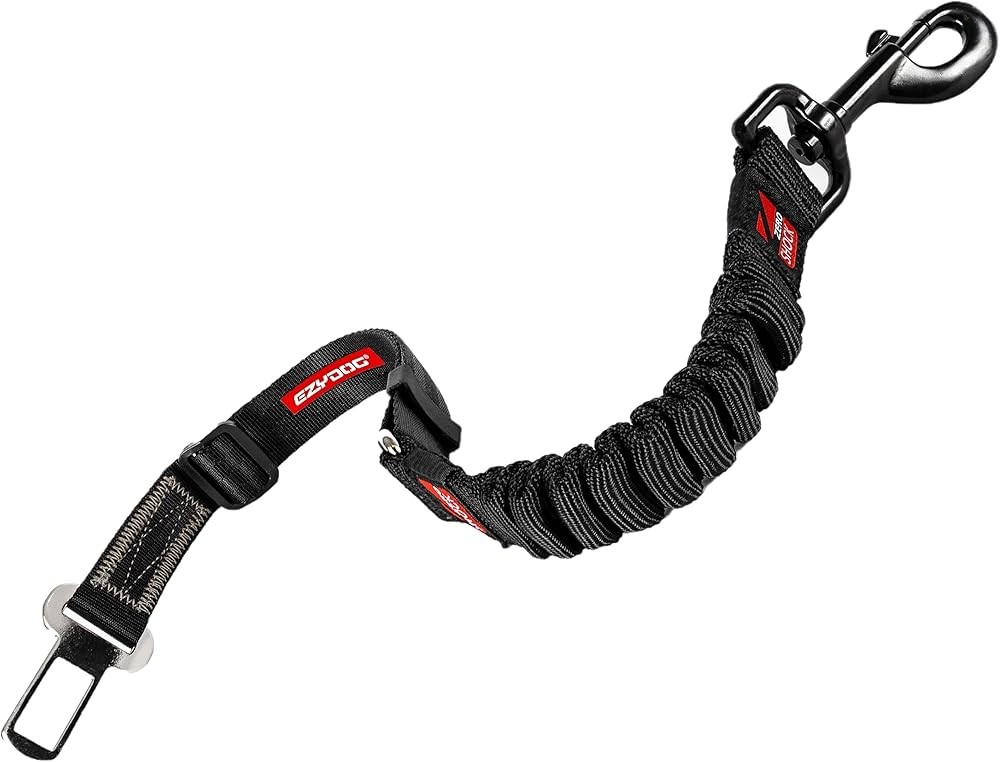
EzyDog Zero Shock Click
Check Price on AmazonAs an Amazon Associate we earn from qualifying purchases.
The EzyDog Zero Shock Click addresses one of the most common issues with vehicle tethering systems: the jarring impact when a moving dog reaches the end of a fixed-length restraint. This innovative seatbelt leash incorporates Zero Shock technology—a shock-absorbing component that cushions sudden movements while maintaining secure restraint during crashes.
Key Features:
- Patented Zero Shock technology with elastic webbing section that absorbs impact
- Quick-release buckle for rapid attachment and removal
- Swivel clip stops tangling during dog movement
- Weather-resistant materials suitable for all-season use
- Reinforced stitching throughout the length
- Works with any car harness (not a standalone restraint—requires separate harness)
- Length extends from 15 inches to 24 inches under normal movement loads
The tether contains a section of elastic webbing engineered to stretch under the low-to-moderate forces generated by a dog shifting position during normal travel. When the dog moves toward the end of the tether length, the elastic section extends gradually, cushioning the motion rather than delivering a hard stop. However, under the high-force loading of a crash scenario, the elastic component reaches its maximum extension and the underlying structural webbing engages to provide full restraint.
This dual-function design creates a more comfortable travel experience for dogs who don’t remain stationary during trips, while maintaining safety performance during crashes. It’s particularly valuable for anxious dogs who benefit from the ability to shift positions without repeatedly experiencing the jarring sensation of reaching a fixed tether limit.
The Zero Shock Click is a tether only—it must be used with a separate car harness like the EzyDog Drive, Active Pets Dog Seatbelt, or similar chest harness. One end clips to the harness’s dorsal D-ring while the other end threads through the vehicle’s seatbelt buckle or attaches to LATCH anchors. This modular approach allows you to upgrade your restraint system’s comfort component without replacing the entire harness.
At $45, the Zero Shock Click costs less than half the price of the Drive harness while adding meaningful comfort benefits. Since it functions as a tether rather than a complete restraint system, you’ll need to factor in the additional cost of a compatible harness. The combination of a quality harness ($80-125) plus the Zero Shock tether ($45) represents a complete premium system totaling $125-170.
Bottom line: The Zero Shock tether ($45) adds shock-absorbing comfort to any car harness—ideal for anxious dogs who struggle against fixed-length restraints.
Best Budget: Active Pets Dog Seatbelt
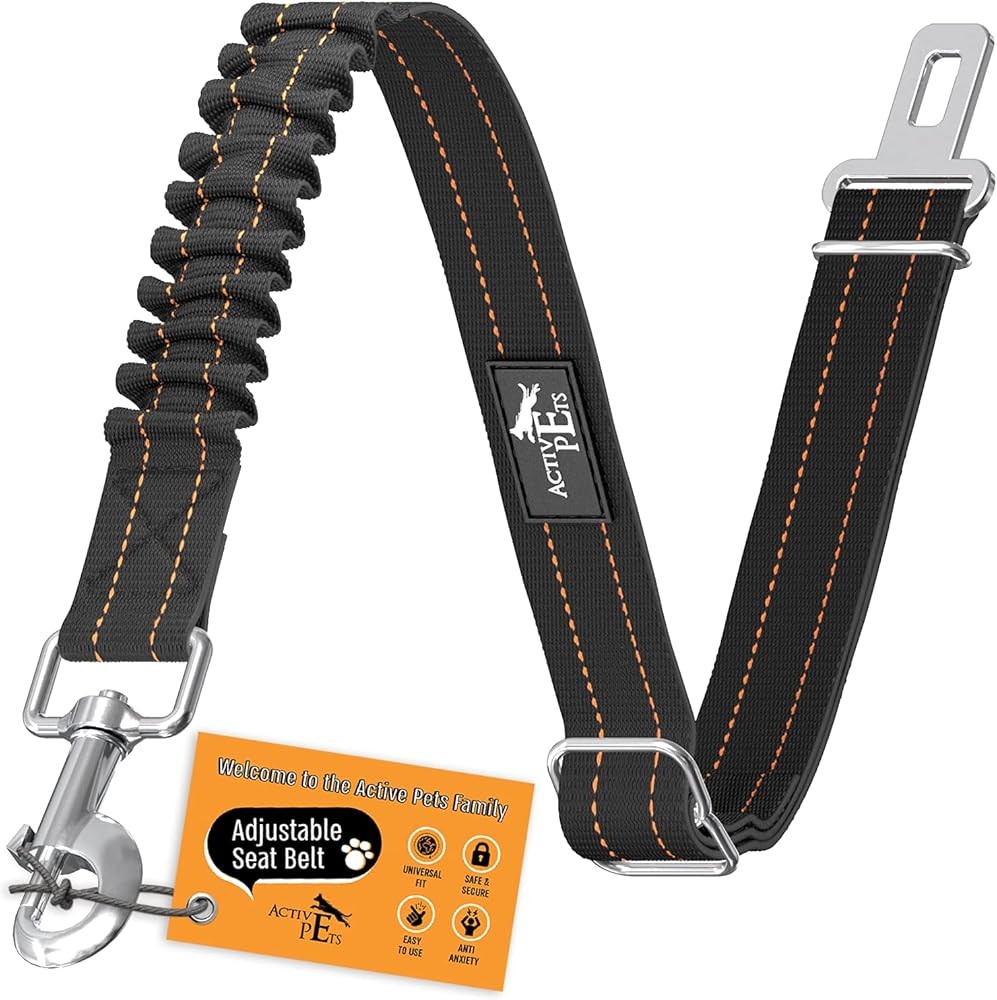
Active Pets Dog Seatbelt
Check Price on AmazonAs an Amazon Associate we earn from qualifying purchases.
The Active Pets Dog Seatbelt delivers essential crash protection features at an accessible price point, making proper vehicle restraint achievable for budget-conscious dog owners. While it lacks the FMVSS 213 certification of premium options like the EzyDog Drive, this harness incorporates key safety design elements found in more expensive products.
Key Features:
- Adjustable chest harness design with four adjustment points
- Universal seatbelt clip compatible with all vehicle restraint systems
- Reflective stitching for visibility during roadside stops
- Padded chest plate to distribute forces and improve comfort
- Heavy-duty nylon webbing rated for impact loads
- Rotating D-ring attachment stops tangling
- Available in four sizes covering 10 to 110+ pound dogs
The harness uses 1-inch nylon webbing for smaller sizes and 1.5-inch webbing for larger dogs—providing adequate material strength for crash restraint. Stitching patterns include reinforced box-X construction at the D-ring attachment point, which represents the highest stress location during sudden deceleration. The chest plate uses moderate padding (less than premium options but sufficient for basic force distribution) covered in durable fabric that resists wear.
Hardware quality represents appropriate specifications for this price point: metal buckles, plastic adjustment sliders, and a swivel clip rated for several hundred pounds of static load. While these components don’t match the premium materials used in $100+ harnesses, they provide functional safety performance for typical use cases.
While the Active Pets harness hasn’t undergone third-party crash testing like CPS or FMVSS 213 protocols, its design incorporates the fundamental elements that safety engineers recognize as essential: force distribution across chest and shoulders rather than neck, structural webbing rated for impact loads well above dog body weight, reinforced attachment points using appropriate stitching techniques, and secure vehicle connection via standard seatbelt infrastructure.
At $20, the Active Pets Dog Seatbelt costs 15-20% of premium certified options while delivering meaningful safety improvements over no restraint. For families managing multiple dogs or tight budgets, this represents excellent value—transforming unrestrained dogs into properly secured passengers at minimal cost.
Bottom line: At $20, the Active Pets harness provides essential chest-distribution safety without certification—good value for budget-conscious owners or multiple-dog households.
Best Value Pack: SlowTon Dog Seat Belt 2-Pack
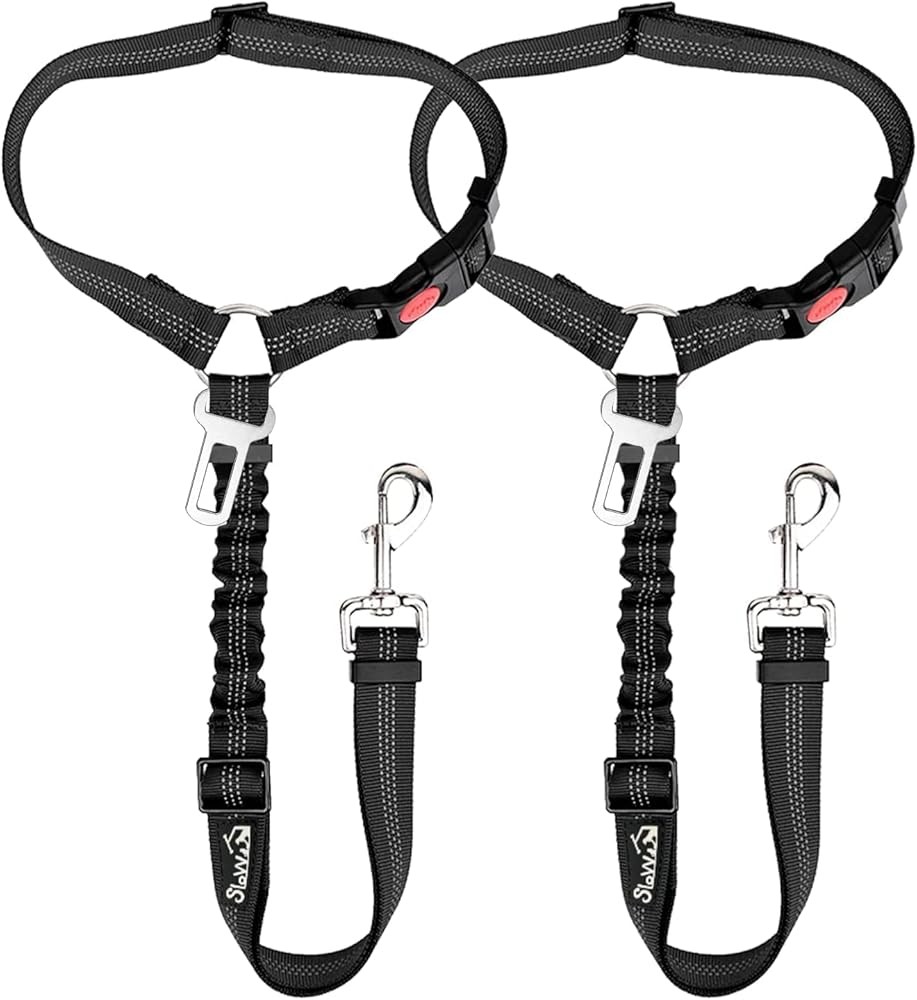
SlowTon Dog Seat Belt 2-Pack
Check Price on AmazonAs an Amazon Associate we earn from qualifying purchases.
The SlowTon Dog Seat Belt 2-Pack addresses a common scenario: households with multiple dogs or owners who need backup restraint systems for different vehicles. At just $12 for two complete harness units, this represents the most economical approach to restraining multiple dogs during vehicle travel.
Key Features:
- Two complete harness and tether systems in single package
- Adjustable design accommodates dogs from 20 to 110 pounds (check sizing carefully for extremes)
- Heavy-duty nylon construction with reinforced stitching
- 360-degree rotating clips stop tangling
- Chest harness design distributes forces safely
- Universal seatbelt attachment compatible with all vehicles
- Available in multiple color combinations (black, red, blue options)
Each package includes two independent restraint systems—meaning you receive two complete chest harnesses and two seatbelt tethers. This configuration allows you to restrain two dogs simultaneously in the same vehicle, keep one harness in each of two different vehicles, maintain a backup system while washing the primary unit, or equip a friend or family member’s vehicle for occasional pet transport.
The harnesses use multi-layer nylon webbing with stitched construction throughout. While the materials don’t match premium harness quality, they provide functional strength for basic restraint purposes. The rotating clips represent a valuable feature at this price point—stopping the frustrating tangling that occurs when dogs change position during travel.
Like the Active Pets option, the SlowTon harness hasn’t undergone formal crash testing. The design incorporates basic safety principles (chest force distribution, structural webbing, reinforced attachment points), but without certification data, its actual crash performance remains unverified. Consider this appropriate for low-to-moderate speed local driving, basic restraint that’s superior to no restraint, budget situations where $6 per dog represents the only economically viable option, and temporary solutions while saving for certified premium harnesses.
At $12 for two complete systems ($6 per dog), this represents the absolute lowest cost entry point for proper vehicle restraint. While you sacrifice the crash-tested performance and premium materials of expensive options, you gain the fundamental safety benefit of restraint versus no restraint—which represents the single largest safety improvement.
Bottom line: Two complete harness systems for $12 ($6 each) make the SlowTon pack ideal for multi-dog households needing basic restraint on tight budgets.
}}
How Should I Install and Use Dog Car Harnesses?
Owning a crash-tested harness provides little safety benefit if installed incorrectly. Proper usage requires attention to multiple factors that determine real-world crash performance.
What Are the Best Vehicle Attachment Methods?
Modern vehicles provide several options for securing pet restraint tethers. The most common method threads the tether through the seatbelt buckle before engaging it. Alternatively, some tethers include a clip that connects directly to the buckled seatbelt. This approach works in all vehicles but provides somewhat less secure attachment than LATCH systems.
Vehicles manufactured since 2000 include LATCH (Lower Anchors and Tethers for Children) systems—metal anchor points designed for child safety seat installation. These same anchors work perfectly for dog restraint tethers, providing the strongest available attachment. LATCH anchors are typically located between and behind rear seat cushions, marked with small tags or symbols, and rated for 65 pounds of static load per anchor.
Using LATCH anchors requires a tether with appropriate hardware (typically a metal clip or carabiner), but provides superior security compared to seatbelt buckle methods.
Some restraint systems loop around rear seat headrest posts. While convenient, this approach generally provides inferior crash performance because headrest posts aren’t designed as structural attachment points, the attachment point sits higher than optimal (increasing forward pitch during crashes), and headrest adjustment mechanisms may fail under impact loads. Use headrest attachment only when seatbelt buckle or LATCH options are unavailable.
What Is the Optimal Seating Position for Dogs?
Safety research on human occupants provides clear guidance that translates well to canine passengers. The center rear seat provides the best protection during side-impact collisions and offers maximum distance from front-seat impact zones during frontal crashes. If your vehicle’s center position includes a seatbelt buckle or LATCH anchors, this represents the optimal location for dog restraint.
The left and right rear seats provide good protection, though slightly inferior to the center position during side impacts. These locations work well for multiple dog households where the center position can accommodate only one dog.
Never secure dogs in front seats due to airbag deployment risks. Front airbags deploy with tremendous force (up to 200 mph) designed to restrain adult humans—a force that can cause fatal injuries to dogs. Even with airbag deactivation, the front seat offers less protection during crashes than rear positions.
SUVs, hatchbacks, and station wagons with cargo areas behind the rear seat can safely accommodate dogs if using properly rated cargo area harnesses with specific attachment points, crash-tested crates secured to cargo anchors or vehicle structure, or barriers stopping the dog from entering the passenger compartment during crashes.
How Long Should the Tether Be?
Tether length affects both comfort and safety. The ideal tether allows the dog to sit, stand, and lie down comfortably, stops the dog from reaching the front seat area, keeps the dog’s head from extending beyond the side window plane (reducing injury risk during side impacts), and maintains the dog in the optimal seating position relative to the attachment point.
Most tethers provide 18-30 inches of working length, which suits the majority of dogs and vehicle configurations. Adjust the length by varying the attachment point (higher or lower D-ring on the harness), using adjustable-length tethers with buckles or sliders, or wrapping excess tether length around the seatbelt (though this approach may reduce crash performance).
How Often Should I Inspect the Harness?
Vehicle harnesses require periodic inspection to maintain safety performance. Monthly checks should examine stitching for fraying, especially at stress points and D-ring attachments, verify buckles, clips, and adjustment mechanisms function smoothly, check webbing for cuts, abrasions, or UV damage (fading indicates material degradation), and ensure padding remains intact and properly positioned.
Replace harnesses annually or when showing any fraying or separation of stitching at critical points, webbing cuts, tears, or abrasions that compromise material strength, bent, cracked, or corroded metal hardware, loss of adjustment function (sliders that won’t hold, buckles that open unexpectedly), or following any crash event—even minor collisions can damage internal harness structures invisibly.
Most harnesses tolerate machine washing on gentle cycles or hand washing in warm water with mild detergent. Air dry completely before use—never place harnesses in dryers as heat degrades synthetic materials and can compromise crash performance. Inspect carefully after washing for any damage caused during the cleaning process.
Bottom line: Attach to LATCH anchors or seatbelt buckles in the rear center seat, keep tether length at 18-30 inches, and inspect monthly for wear.
What Other Vehicle Safety Factors Matter for Dogs?
Beyond the harness itself, several factors contribute to overall dog vehicle safety.
How Do I Manage Temperature During Travel?
Dogs experience heat stress more rapidly than humans due to limited cooling mechanisms (panting vs. sweating). During vehicle travel, never leave dogs in parked vehicles during warm weather—temperatures rise to dangerous levels within minutes even with windows cracked. Use climate control to maintain comfortable cabin temperatures (60-75°F optimal for most dogs), provide water access during extended trips using spill-proof bowls, monitor for heat stress signs including excessive panting, drooling, lethargy, and disorientation, and consider cooling vests or mats for dogs with thick coats or brachycephalic breeds prone to overheating.
Why Does Cargo Security Matter?
Loose items in the vehicle become projectiles during crashes, potentially injuring restrained dogs. Secure food and water bowls, toys and chew items, luggage and cargo, and emergency supplies. Use cargo nets, organizers, or secured containers to stop loose items from striking the dog during sudden stops or collisions.
What Emergency Supplies Should I Keep?
Maintain vehicle emergency supplies for dog travel. Ensure dogs wear collars with current ID tags and microchip registration. Keep vaccination records and emergency vet contact information accessible. Include items for both human and canine injuries in first aid kits. Keep leash and backup restraint to enable safe handling if primary harness fails. Maintain recent photos to aid identification if the dog escapes during crash aftermath. Store food and water to support multi-hour delays following crashes or breakdowns.
How Can I Manage Motion Sickness?
Some dogs experience nausea and vomiting during vehicle travel. Support affected dogs with gradual acclimation through short positive trips before extended travel, limiting food consumption 2-3 hours before travel, positioning to allow forward-facing views (reduces motion sickness in some dogs), veterinary motion sickness medications (maropitant citrate/Cerenia) for severe cases, and frequent stops allowing dogs to exit the vehicle and decompress.
What Legal Requirements Apply?
Research state and local regulations regarding pet vehicle transport in areas where you travel regularly. Some jurisdictions require physical restraint systems meeting specific standards, prohibition on pets in driver’s lap or footwell areas, fines for violations ranging from $50-500+, and animal cruelty charges for particularly egregious violations.
Beyond legal requirements, insurance considerations matter. Some auto insurance policies include provisions regarding pet transport that could affect claim processing following crashes involving unrestrained animals.
Bottom line: Maintain 60-75°F cabin temperature, secure all loose cargo, keep emergency supplies including ID and medical records, and research state pet restraint laws.
What Common Mistakes Should I Avoid?
Understanding frequent errors helps maximize safety effectiveness.
Why Can’t I Use Regular Walking Harnesses for Car Restraint?
Standard walking harnesses lack the structural reinforcement, impact-rated materials, and crash-tested design of purpose-built car harnesses. The forces generated during even low-speed crashes far exceed the loads experienced during walks—making walking harnesses prone to stitching failure at stress points, buckle separation under impact loads, material tearing or deformation, and inadequate force distribution causing injury despite restraint.
Always use purpose-designed car harnesses for vehicle travel. Walking harnesses serve a different function with different engineering requirements.
Why Are Collars Dangerous for Vehicle Restraint?
Collars concentrate crash forces on the dog’s neck and trachea—creating severe injury risk during sudden deceleration. Even wide collars lack adequate force distribution to avoid neck trauma. Research on canine neck injuries demonstrated that collar-based restraint during crashes resulted in tracheal collapse and crush injuries, cervical vertebrae fractures, soft tissue damage to throat structures, and strangulation in extreme cases.
Harnesses distributing forces across the chest and shoulders represent the only safe restraint approach for vehicle travel.
Why Is Excessive Tether Length Dangerous?
Long tethers permitting dogs to move throughout the rear seat area or into the front footwell defeat the safety purpose by allowing the dog to build momentum before the tether engages during crashes, enabling head strikes against windows, seats, or other surfaces, permitting interaction with driver or front passenger that creates distraction, and reducing the restraint system’s effectiveness during impacts.
Tether length should allow comfortable position changes while keeping the dog contained to a defined safe zone.
Why Must I Check Fit After Weight Changes?
Dogs experience weight fluctuations due to growth (puppies and young adults), seasonal weight variation, age-related changes, and health conditions affecting body mass. Harness fit must be reassessed periodically—especially after noticeable weight changes. A harness that fit properly when the dog weighed 45 pounds may be dangerously loose or uncomfortably tight at 55 or 35 pounds. Check fit every 3-6 months and always after significant weight changes.
Can I Share Harnesses Between Dogs?
Each dog requires an individually fitted harness adjusted specifically for their body proportions. While the same harness model may work for multiple dogs, the adjustment settings will differ. Never transport a dog in a harness configured for a different animal without complete readjustment and fit verification.
The one exception: identical-size littermates or dogs with very similar builds may share properly fitted harnesses if necessary, though individual harnesses remain preferable from both hygiene and emergency response perspectives (first responders need to quickly restrain multiple dogs separately following crashes).
Bottom line: Never use walking harnesses or collars for vehicle restraint, limit tether to 18-30 inches, recheck fit after weight changes, and provide individual harnesses per dog.
How Does Training Support Safe Vehicle Travel?
While physical restraint provides essential crash protection, behavioral training contributes significantly to overall vehicle safety and positive travel experiences.
How Can I Acclimate My Dog to the Harness?
Dogs unaccustomed to harnesses or vehicle restraint may initially resist or show anxiety. Systematic desensitization helps through multiple phases.
Phase 1: Harness Familiarization (3-7 days) involves allowing the dog to investigate the harness through sniffing and exploration, pairing harness presence with positive experiences (food rewards, play, praise), practicing putting on and removing the harness without travel, and rewarding calm behavior during harness wear around the house.
Phase 2: Stationary Vehicle Time (3-7 days) includes securing the dog in the parked vehicle with engine off, providing food rewards, toys, or meals while restrained, keeping sessions brief (5-15 minutes) and positive, and gradually extending duration as the dog relaxes.
Phase 3: Short Trips with Positive Destinations (1-2 weeks) means driving brief distances (5-10 minutes) to highly positive locations (parks, friend’s house, etc.), avoiding early trips to negative locations like veterinary clinics, rewarding calm behavior during and after travel, and gradually extending trip duration and complexity.
Phase 4: Regular Travel Integration incorporates normal destination variety including necessary trips, maintaining positive associations through periodic high-value destinations, continuing to reward calm restrained behavior, and addressing any anxiety signs with patience and possible veterinary consultation.
How Do I Teach Settling Behaviors?
Teaching dogs to settle calmly during restrained travel improves both safety and comfort. Use calming cues (“settle,” “easy,” or similar consistent commands), reward spontaneous calm behavior with praise and occasional food rewards, consider calming aids like pheromone sprays or supplements for anxious dogs, provide appropriate chew items that occupy without creating choking hazards, and avoid reinforcing anxious behaviors through excessive attention or food rewards.
What Emergency Commands Should Dogs Know?
Train dogs to respond to basic commands while restrained, enabling safer emergency management. Stay stops the dog from bolting when the harness is released. Come enables controlled exit from the vehicle during emergencies. Wait creates a pause between harness release and exit allowing you to attach a leash. Down helps calm excited dogs and reduces injury risk during necessary delays.
Practice these commands specifically in the vehicle environment where restraint, confined space, and distractions create different challenges than home training contexts.
Bottom line: Acclimate dogs gradually over 2-4 weeks using positive reinforcement, reward calm settling behaviors, and practice emergency commands in the vehicle environment.
What Does the Research Show About Dog Car Safety?
Final Recommendations for Canine Vehicle Safety
The physics of vehicle crashes remain unforgiving: sudden deceleration transforms dogs into dangerous projectiles capable of causing severe injury to themselves and human occupants. Proper restraint systems address this fundamental safety challenge through crash-engineered harnesses, secure vehicle attachment, and appropriate installation practices.
The research evidence supports clear conclusions. Unrestrained dogs face severe injury risk during even moderate-speed collisions, with documented trauma patterns including orthopedic injuries, internal organ damage, and fatal outcomes. Proper chest harnesses significantly reduce injury risk by distributing crash forces across skeletal structures designed to withstand compressive loads. Third-party crash testing provides essential verification that products meet meaningful safety standards rather than vague marketing claims. Owner restraint rates remain inadequate with fewer than 20% of dogs properly secured during vehicle travel, suggesting major gaps in safety awareness and practice.
For owners seeking the highest available safety assurance, FMVSS 213-certified harnesses like the EzyDog Drive represent the gold standard—providing the same level of crash-tested protection required for human child restraints. Budget-conscious families can achieve meaningful safety improvements through properly designed harnesses like the Active Pets Dog Seatbelt or SlowTon 2-Pack systems, though these lack independent certification data.
Regardless of which specific product you choose, the single most important decision involves transitioning from unrestrained to restrained travel. The safety improvement from no restraint to even basic harness restraint dwarfs the incremental difference between basic and premium harness options.
Beyond the harness itself, safe dog vehicle travel requires proper installation using seatbelt buckles or LATCH anchors in optimal rear seat positions, correct sizing with adjustment achieving snug but comfortable fit, regular inspection identifying wear or damage requiring replacement, behavioral training supporting calm restrained travel, and emergency preparedness for crash aftermath scenarios.
The dogs who share our lives and homes depend on us to make informed safety decisions on their behalf. Vehicle restraint represents a fundamental responsibility of dog ownership—as essential as nutritious food, veterinary care, and safe home environments. The modest investment in a proper car harness and the brief time required for correct installation provide protection that could prove literally lifesaving during the inevitable unexpected event.
Your dog trusts you to keep them safe. Make that trust well-founded by ensuring proper vehicle restraint on every trip.
-
Hazel SJ, Kogan LR, Montrose VT, Hebart ML, Oxley JA. Restraint of dogs in vehicles in the US, UK and Australia. Prev Vet Med. 2019;170:104714. doi:10.1016/j.prevetmed.2019.104714. PMID: 31421492.
-
Center for Pet Safety. CPS Certified Pet Products and Testing Protocols. Available at: https://www.centerforpetsafety.org/
-
National Highway Traffic Safety Administration. Federal Motor Vehicle Safety Standards; Child Restraint Systems. 49 CFR § 571.213. Available at: https://www.nhtsa.gov/
-
American Kennel Club. Safe Car Travel with Your Dog: A Comprehensive Guide. Available at: https://www.akc.org/expert-advice/
-
American Veterinary Medical Association. Traveling with Your Pet by Car: Safety Guidelines. Available at: https://www.avma.org/resources/pet-owners/
-
Landsberg G, Hunthausen W, Ackerman L. Behavior Problems of the Dog and Cat. 3rd ed. Saunders Elsevier; 2013.
-
Overall KL. Manual of Clinical Behavioral Medicine for Dogs and Cats. Elsevier; 2013.
-
AAA Foundation for Traffic Safety. Pet Passenger Safety Study. Available at: https://aaafoundation.org/
-
Journal of Veterinary Behavior. Special issue on canine travel behavior and anxiety management. Various articles 2018-2024.
-
Insurance Institute for Highway Safety. Vehicle Safety Research Including Pet Restraint Systems. Available at: https://www.iihs.org/
- Restraint of dogs in vehicles in the US, UK and Australia.. PubMed 31421492
- The Carle-Illinois (Urbana, Illinois USA) Transport Protocol for LEK9s: Guidelines for Emergency Medical Service Providers.. PubMed 31244449
- Assessment of two external telemetry systems (PhysioJacket and JET) in beagle dogs with telemetry implants.. PubMed 19426820
- Restraint of dogs in vehicles in the US, UK and Australia.. PubMed 31421492
- The Carle-Illinois (Urbana, Illinois USA) Transport Protocol for LEK9s: Guidelines for Emergency Medical Service Providers.. PubMed 31244449
- Assessment of two external telemetry systems (PhysioJacket and JET) in beagle dogs with telemetry implants.. PubMed 19426820
References
- Restraint of dogs in vehicles in the US, UK and Australia. PubMed 31421492
For more context, see our guides on Best Dog First Aid Kits: Emergency Preparedness for Your Pet and Best Dog Cooling Vests for Summer Safety.
Related Reading
- Best Dog Anxiety Vests and Calming Wraps - Thundershirt and other pressure therapy options for anxious dogs during travel and stressful situations
- Best Dog Strollers for Senior and Disabled Dogs - Alternative transport options for dogs unable to tolerate extended vehicle travel
- Best Dog Ramps for Senior Dogs with Arthritis - Loading assistance for older dogs entering vehicles safely
- Best Dog Wheelchairs and Mobility Carts - Mobility support for dogs with paralysis or severe orthopedic conditions
- Best Cooling Dog Beds for Summer - Temperature management for dogs in hot vehicle environments
How Do Different Dog Breeds Require Different Harness Approaches?
Dog body types vary dramatically across breeds, creating unique fitting and safety considerations that affect harness selection and installation.
Brachycephalic Breeds and Respiratory Concerns
Short-nosed breeds including Bulldogs, Pugs, Boston Terriers, French Bulldogs, and Shih Tzus experience compromised airway function that demands special attention during vehicle travel. These dogs already struggle with breathing due to anatomical features including stenotic nares (narrow nostrils), elongated soft palates, and hypoplastic tracheas (narrow windpipes).
Vehicle restraint harnesses for brachycephalic breeds require wider chest plates that distribute pressure away from the throat and upper airway, padded contact surfaces that avoid any compression of already-compromised breathing structures, secure fit without over-tightening that could restrict chest expansion, and positioning that allows the head to remain elevated rather than flexed downward.
Beyond harness selection, brachycephalic dogs need enhanced climate control maintaining temperatures below 70°F, excellent air circulation throughout the vehicle, frequent rest stops allowing recovery from travel stress, water access to support cooling through panting, and close monitoring for signs of respiratory distress including blue-tinged gums, excessive drooling, or weakness.
Some severely affected brachycephalic individuals may tolerate properly sized crates better than harnesses since crates eliminate any contact pressure on the chest or throat while still providing crash protection through containment.
Deep-Chested Breeds and Harness Stability
Breeds with deep, narrow chest conformations including Greyhounds, Whippets, Salukis, Dobermans, and Great Danes present unique fitting challenges. Standard harness designs often slide forward on these dogs’ streamlined bodies, reducing both comfort and safety effectiveness.
Harnesses for deep-chested breeds should feature martingale-style chest straps that tighten slightly when pulled but loosen during normal movement, preventing forward slippage without restricting breathing, Y-shaped front designs that conform to narrow chest geometry, and multiple adjustment points accommodating the extreme depth-to-width ratio of these body types.
The tendency for harnesses to shift forward on sighthounds makes frequent fit checks especially important—verify positioning after the first 10 minutes of travel and adjust as needed.
Short-Legged and Long-Backed Breeds
Dachshunds, Corgis, Basset Hounds, and similar breeds with elongated spines relative to leg length require harness designs that provide adequate back support without creating pressure points along the extended torso. Standard harnesses designed for more proportional body types often create gaps or excessive pressure when adapted to these unique conformations.
Look for harnesses with extended back panels that distribute forces along more of the spine, close spacing between chest and back attachment points to avoid twisting forces on the long spine, and adjustability that accommodates the unusual body proportions without compromising either fit or safety.
The spinal anatomy of these breeds makes proper restraint especially critical—unrestrained travel poses heightened risk of intervertebral disc injury during sudden stops or collisions due to the mechanical stress on their elongated backs.
Giant Breeds and Hardware Strength
Dogs exceeding 100 pounds including Great Danes, Mastiffs, Saint Bernards, and Newfoundlands require harnesses specifically engineered for their mass. Standard harnesses designed for average-sized dogs may use hardware and webbing inadequate for the forces generated by giant breed body weight during crashes.
Giant breed harnesses must incorporate 2-inch or wider webbing to distribute forces across sufficient surface area, metal hardware rated for loads exceeding 1000 pounds, reinforced stitching using heavy-duty thread at all stress points, and padding substantial enough to cushion the extreme forces generated by large mass during deceleration.
A 120-pound dog traveling at 35 mph generates approximately 4,800 pounds of force during sudden deceleration—more than two tons of impact load that demands appropriately engineered restraint systems. Never use harnesses sized for smaller dogs on giant breeds regardless of claimed weight ranges—the materials and construction may prove inadequate for actual crash loads.
Toy Breeds and Miniature Harness Systems
Dogs under 10 pounds including Chihuahuas, Yorkshire Terriers, Pomeranians, and Maltese require harnesses scaled appropriately for their delicate structure. Standard harnesses create excessive bulk and weight relative to tiny body mass, while inadequate adjustment ranges avoid secure fit.
Toy breed harnesses should use lighter-weight materials that don’t overwhelm small frames while maintaining adequate crash protection, narrower webbing (typically 0.5-0.75 inches) sized appropriately for small chest circumferences, gentler padding that provides protection without excessive bulk, and fine-tuned adjustment mechanisms allowing precise sizing.
Despite their small size, toy breeds still require proper restraint—a 5-pound dog generates 200 pounds of force at 35 mph, sufficient to cause serious injury during unrestrained travel. The perception that small dogs don’t need restraint because they can’t cause harm to human occupants ignores the severe risk to the dog itself.
Bottom line: Match harness design to breed anatomy—brachycephalic dogs need wide chest plates avoiding throat pressure, sighthounds need martingale-style anti-slip designs, long-backed breeds need extended spine support, giants need heavy-duty hardware, and toys need scaled-down materials.
What Role Does Behavior Modification Play in Travel Safety?
While physical restraint provides the foundation of vehicle safety, behavioral training creates the psychological framework that makes restraint tolerable and reduces travel-related stress.
Addressing Pre-Existing Travel Anxiety
Many dogs develop negative associations with vehicle travel through unfortunate experiences—motion sickness during early trips, traumatic visits to veterinary clinics, or simply the unfamiliarity of the vehicle environment. These negative associations can create significant anxiety that complicates restraint acceptance and overall travel safety.
Systematic counter-conditioning helps rebuild positive associations with vehicles and travel. Begin by feeding highly valued food rewards in the stationary vehicle with the engine off, creating positive experiences completely disconnected from actual travel. Progress to brief engine-running sessions while parked, then very short trips (literally around the block) that end at highly positive destinations like parks or friends’ homes where the dog receives play time and attention.
The key involves keeping each step well below the dog’s anxiety threshold—the dog should remain relaxed and willing to eat addresses throughout each session. If anxiety emerges (panting, drooling, refusal to eat), the current step exceeds the dog’s comfort level and requires backing up to an easier stage.
For dogs with severe travel anxiety resistant to behavioral modification alone, veterinary consultation regarding anti-anxiety medications or supplements may prove necessary. Options include prescription medications like trazodone or alprazolam given 1-2 hours before travel, over-the-counter supplements including L-theanine, CBD, or pheromone products, and long-term behavior modification medications like fluoxetine for chronic anxiety cases.
Building Positive Restraint Associations
Dogs naturally resist physical restraint until they learn it predicts positive outcomes. Build these associations by pairing harness wearing with highly valued experiences—put the harness on before meals, during play sessions, or when giving special addresses rather than only before vehicle travel.
Practice brief harness-wearing periods around the house while engaging in normal activities, gradually extending duration until the dog tolerates wearing the harness for 30-60 minutes without signs of stress. This habituation process creates a neutral or positive emotional response to the physical sensation of wearing the harness, making vehicle restraint more acceptable.
Once the dog tolerates the harness calmly in familiar environments, begin associating it specifically with vehicle travel while maintaining positive outcomes—ensure early restrained trips lead to fun destinations rather than neutral or negative locations.
Managing Excitement and Over-Arousal
While anxiety represents one behavioral challenge, opposite-spectrum excitement and hyper-arousal create different safety concerns. Dogs who become intensely excited about car rides may struggle, vocalize excessively, or engage in behaviors that create driver distraction despite proper physical restraint.
Teach settle behaviors specifically in the vehicle context using a marker word or clicker to identify and reward calm behavior. Wait for spontaneous moments when the dog sits or lies quietly while restrained, immediately mark the behavior with “yes” or a click, and deliver a food reward. Over multiple sessions, these moments of calm increase in frequency as the dog learns they produce rewards.
Pre-travel exercise helps reduce arousal levels—a 20-30 minute walk or vigorous play session before vehicle travel exhausts some physical energy, making calm restrained behavior more achievable. Mental stimulation through training sessions or puzzle feeders before travel similarly reduces arousal.
For chronic over-arousal cases, consider calming supplements given 30-60 minutes before travel. Research on canine calming aids demonstrates several compounds including L-theanine, alpha-casozepine, and CBD show promise for reducing anxiety and over-arousal without sedation.
Establishing Travel Routines
Dogs thrive on predictable routines that reduce uncertainty and anxiety. Establish consistent pre-travel sequences that help the dog anticipate and mentally prepare for vehicle trips. This might include putting on the harness in a specific location, walking to the vehicle via the same path, entering through a consistent door, and receiving a specific toy or chew item once secured.
These ritualized sequences create psychological preparedness—the dog understands what’s coming and can transition into travel mode more smoothly. Disrupting established routines increases uncertainty and stress, while maintaining consistency supports calm cooperation.
Bottom line: Combine systematic desensitization (gradual positive exposure), counter-conditioning (pairing vehicle/harness with rewards), pre-travel exercise, and consistent routines to address anxiety, over-arousal, and restraint resistance behaviorally.
How Do Seasonal and Weather Conditions Affect Vehicle Safety?
Environmental factors create variable safety considerations that require adaptation of restraint strategies and travel protocols.
Summer Heat and Temperature Management
Vehicle interiors reach dangerous temperatures rapidly during warm weather—even with windows cracked, interior temperatures can exceed 120°F within 20 minutes on 80°F days. Dogs restrained in vehicles face particular risk because they cannot move to seek cooler areas.
Never leave restrained dogs in parked vehicles during warm weather for any duration—the restraint system becomes a deadly trap preventing the dog from escaping rising temperatures. Even brief stops (5-10 minutes) can prove fatal during summer conditions.
During travel with climate control active, maintain cabin temperatures between 60-70°F for dogs—cooler than many humans prefer but appropriate for dogs wearing harnesses that add insulation. Monitor the dog’s position relative to air vents, ensuring adequate air circulation reaches the restrained area. Rear seats often receive less air flow than front positions, requiring verification that cooling reaches the dog effectively.
Provide water access during trips exceeding 30 minutes using secure spill-proof bowls or water bottles with attached bowls. Dehydration develops quickly in warm environments, especially for dogs already stressed by travel.
Watch for heat stress signs including excessive panting with the tongue extended far from the mouth and curled at the edges, bright red or purple gums and tongue, thick ropy saliva or excessive drooling, weakness or inability to stand, and disorientation or unresponsiveness. These symptoms constitute medical emergencies requiring immediate cooling and veterinary attention.
Cooling accessories including gel-filled cooling vests worn under harnesses, frozen water bottles placed near (not directly against) the dog, and cooling pads on the seat surface help maintain safe body temperatures during summer travel.
Winter Cold and Hypothermia Risk
While less immediately dangerous than heat, cold environments create risks especially for small, thin-coated, or elderly dogs. Vehicle interiors lose heat rapidly when parked, and even climate-controlled vehicles may have cold spots near windows or in cargo areas.
Short-haired breeds and toy dogs may require insulated jackets or sweaters worn under vehicle harnesses during winter travel. These layers provide warmth without compromising harness fit—put the clothing on first, then install the harness over it while ensuring the harness still achieves proper snug fit.
During cold-weather stops, minimize time with the engine off. If extended stops become necessary, cover the dog with blankets while maintaining restraint security. Never leave dogs restrained in vehicles without functioning heat during freezing weather—the restraint stops them from moving to generate warmth or seeking shelter.
Rain, Snow, and Wet Conditions
Wet weather creates slippery conditions during loading and unloading plus challenges keeping harnesses and dogs dry. Moisture affects both safety and comfort.
Use non-slip mats or towels on seats to provide traction for wet paws—dogs entering vehicles with wet feet may slip on leather or vinyl surfaces. Keep absorbent towels accessible to dry dogs before securing harnesses, as wet fur against harness webbing causes chafing and discomfort during extended wear.
Wet harnesses require thorough drying before storage to avoid mold and material degradation. After trips in wet conditions, remove harnesses and hang to air dry completely before next use. Inspect wet harnesses carefully for any waterborne damage to stitching or hardware.
Seasonal Allergies and Air Quality
Spring and fall bring increased pollen loads affecting dogs with seasonal allergies. Vehicle travel concentrates airborne allergens in the confined cabin space, potentially exacerbating respiratory symptoms.
Use cabin air filters and keep windows closed during high pollen conditions. Consider running climate control on recirculation mode to reduce fresh air intake of allergen-laden outside air. For dogs with significant seasonal allergies, consult your veterinarian about antihistamines or other medications that can be given before travel to reduce symptoms.
Poor air quality from wildfire smoke, urban pollution, or other sources similarly affects dogs during vehicle travel. Monitor air quality indices and minimize travel during severe air quality events when possible. Dogs with respiratory conditions including brachycephalic breeds or those with chronic bronchitis face heightened risk during poor air quality.
Bottom line: Maintain 60-70°F cabin temperature, never leave restrained dogs in parked vehicles during temperature extremes, provide water access on trips over 30 minutes, use cooling/warming accessories seasonally, and monitor air quality for respiratory protection.
What Are the Legal and Insurance Implications of Pet Restraint?
Beyond safety, pet vehicle restraint involves legal and financial considerations that affect owners differently across jurisdictions and insurance policies.
State-Level Pet Restraint Laws
While no federal law mandates pet vehicle restraint, several states have enacted relevant legislation. Rhode Island law prohibits carrying dogs in vehicles in ways that could jeopardize the dog’s safety, interpreted to include unrestrained transport. New Jersey prohibits transporting animals in cruel or inhumane manners, which authorities may apply to unrestrained transport creating injury risk. Hawaii bans drivers from operating vehicles with pets in their laps. Connecticut specifically prohibits transporting dogs in truck beds without proper crates or restraints. Arizona law prohibits transporting dogs in vehicle cargo areas or truck beds on highways if proper enclosure or restraint is lacking.
Penalties for violations vary by jurisdiction but typically range from $50-$300 fines plus potential animal cruelty charges in severe cases. While enforcement rates remain relatively low, citations do occur especially following accidents involving unrestrained pets or when combined with other traffic violations.
Beyond specific pet restraint statutes, general distracted driving laws in many states can apply when unrestrained pets interfere with vehicle operation. If an unrestrained dog causes an accident by distracting the driver or interfering with vehicle controls, the driver may face liability beyond standard traffic citations.
Insurance Policy Considerations
Auto insurance policies contain various provisions potentially affected by pet transport practices. Some insurers include pet injury coverage as optional endorsements or standard components of comprehensive policies, with limits typically ranging from $500-$5,000 per pet. This coverage addresses veterinary costs if pets are injured during covered accidents.
However, policy language may include exclusions for improperly transported animals. If investigation determines an unrestrained pet contributed to an accident, insurers might deny or reduce claims under provisions excluding losses resulting from policy violations or negligent practices. While case law on this topic remains limited, the theoretical liability exists.
Liability coverage becomes relevant when unrestrained pets cause accidents by distracting drivers or becoming projectiles that injure other occupants. If your unrestrained dog causes you to lose control and injure others, your liability coverage would address third-party claims, but you might face increased premiums or non-renewal following such events.
Some commercial auto policies for ride-sharing or pet transport businesses explicitly address animal restraint requirements and may mandate specific restraint systems as conditions of coverage. Review policy terms carefully if transporting pets professionally.
Liability in Accidents Involving Unrestrained Pets
Civil liability can arise when unrestrained pets contribute to accidents. If your unrestrained dog distracts you, causing an accident that injures others, injured parties may pursue damages including medical costs, lost wages, pain and suffering, and property damage. Your auto liability insurance provides defense and pays damages up to policy limits, but establishing that inadequate pet restraint constituted negligence could strengthen plaintiffs’ cases.
If an unrestrained dog becomes a projectile that injures passengers in your vehicle, those passengers could potentially pursue claims against you as the driver responsible for ensuring safe transport conditions. While such claims might face defenses based on assumption of risk if passengers knew the dog was unrestrained, the legal landscape varies by jurisdiction.
Following serious accidents, authorities may investigate whether unrestrained pets contributed to crashes. Findings of inadequate restraint could result in additional citations beyond standard traffic violations, potentially including reckless driving or animal cruelty charges depending on circumstances and outcomes.
Bottom line: Several states mandate pet restraint with $50-$300 fines, insurance policies may reduce coverage when unrestrained pets contribute to accidents, and civil liability can arise when inadequate restraint causes injuries—making proper restraint important legally and financially beyond pure safety considerations.
Recommended Products