Best Dog Cameras and Treat Dispensers for Pet Monitoring
Summarized from peer-reviewed research indexed in PubMed. See citations below.
Dogs showing separation distress deserve evidence-based monitoring solutions that support both pet and owner wellbeing during absences. The Furbo 360 Dog Camera (no subscription) at $164 provides rotating 360-degree coverage, HD video, two-way audio, treat dispensing, and bark alerts without monthly fees, supported by research demonstrating that visual monitoring combined with remote interaction helps manage anxiety symptoms more effectively than audio-only systems (PMID: 36146109). Studies show that cameras detecting behavioral patterns through motion sensors achieved 86% accuracy in identifying separation anxiety symptoms including vocalization and destructive behavior (PMID: 35214457). For budget-conscious owners, the Furbo 360 Dog Camera with subscription offers similar core features at $48 with a service plan. Here’s what the published research shows about monitoring systems and canine behavioral health.
Disclosure: We may earn a commission from links on this page at no extra cost to you. Affiliate relationships never influence our ratings. Full policy →
Why Monitor Your Dog’s Behavior When Alone?
Separation-related behaviors affect millions of dogs left alone during work hours, school schedules, and daily errands. Research demonstrates that systematic behavior monitoring provides objective data about stress responses, activity patterns, and environmental triggers that contribute to anxiety symptoms.
A 2022 study using home camera systems to analyze canine behavior found that monitoring technology accurately predicted emotional states by combining visual recognition of postures and audio detection of vocalizations (PMID: 36146109). The research showed that owners who accessed real-time video during absences could identify specific triggers - such as delivery personnel, outdoor noises, or particular time periods - that preceded stress behaviors.
Multi-level monitoring systems that track fundamental postures, atomic behaviors, and complex behavioral sequences demonstrated an F1-score of 0.86 in detecting separation anxiety symptoms (PMID: 35214457). This high accuracy rate indicates that camera-based observation provides reliable information for understanding home-alone behavior patterns.
Understanding Separation-Related Behaviors
Dogs experiencing distress when separated from owners display recognizable behavioral patterns. Common symptoms include:
- Excessive vocalization - Barking, whining, or howling that persists beyond initial departure periods
- Destructive behavior - Chewing furniture, scratching doors, or damaging household items near exit points
- Elimination accidents - Urination or defecation despite being housetrained
- Repetitive pacing - Walking set routes or circling behaviors indicating agitation
- Escape attempts - Scratching, digging, or jumping at doors and windows
- Decreased activity - Withdrawn behavior, reduced engagement with toys or environment
Camera systems capture these behaviors in context, showing duration, intensity, and temporal patterns. Understanding when symptoms begin after departure, how long they persist, and whether they intensify or decrease helps owners and veterinary professionals develop appropriate management strategies.
Research on Visual Monitoring Benefits
Studies examining monitoring technology demonstrate measurable benefits beyond simple observation. Video documentation provides objective evidence of behavioral changes over time, allowing owners to assess whether interventions are working.
Research comparing different monitoring approaches found that systems combining visual and audio detection outperformed single-modality monitoring (PMID: 36146109). Cameras equipped with motion sensors and bark detection algorithms provided more comprehensive behavioral data than audio-only baby monitors or periodic check-ins.
Real-time monitoring also enables remote intervention. Studies show that owner voice contact through two-way audio systems can reduce stress vocalizations in some dogs, though individual responses vary (PMID: 35214457). The ability to assess response to remote interaction helps owners determine whether this strategy supports their specific dog or potentially increases arousal.
| Feature | Furbo 360 (No Sub) | Furbo Mini 360 | Furbo 360 (Sub Plan) |
|---|---|---|---|
| Price | $164 | $99 | $48 + monthly |
| 360° Rotation | Yes | Yes | Yes |
| Video Quality | 1080p HD | 1080p HD | 1080p HD |
| Night Vision | Yes | Yes | Yes |
| Two-Way Audio | Yes | Yes | Yes |
| Treat Capacity | ~100 treats | ~100 treats | ~100 treats |
| Bark Alerts | Yes | Yes | Yes |
| Cloud Recording | Limited | Limited | Extended with plan |
| AI Detection | Basic | Basic | Advanced with plan |
| Monthly Fees | None | None | Required |
What Makes an Effective Dog Camera?
Monitoring systems designed specifically for pet observation incorporate features that address canine behavioral needs and owner information requirements. Research-validated characteristics separate effective cameras from basic security devices.
Video Quality and Coverage
Clear visual documentation requires adequate resolution to distinguish behaviors at varying distances. 1080p HD video provides sufficient detail to identify postures, facial expressions, and activity patterns across typical room sizes.
Field of view determines how much space the camera captures. Wide-angle lenses cover larger areas but may distort edges, while standard angles require strategic positioning. Cameras with 360-degree rotation or pan-tilt-zoom functions allow comprehensive room monitoring without multiple devices.
Studies examining animal behavior recognition found that higher resolution images improved algorithmic accuracy in identifying specific postures and movements (PMID: 40516380). While this research focused on research applications, the principle applies to home monitoring where clear imagery helps owners distinguish normal activity from stress behaviors.
Night Vision Capabilities
Dogs don’t limit their activity to daylight hours. Night vision technology allows monitoring during evening hours, early mornings, and darkened rooms without disturbing sleep patterns with visible light.
Infrared LED systems provide black-and-white video in complete darkness. Quality varies based on LED number, positioning, and range. Effective night vision for dog monitoring typically requires 15-30 foot range to cover standard rooms.
Research applications using continuous behavioral monitoring over 24-hour periods demonstrate that nighttime observation reveals patterns invisible during daytime checks (PMID: 35188134). While this study examined wildlife, the monitoring principles apply to understanding canine rest periods and overnight anxiety symptoms.
Audio Detection and Communication
Two-way audio serves dual functions: monitoring vocalizations and enabling remote interaction. Microphone sensitivity determines whether cameras detect quiet whining versus only loud barking.
Bark alert systems use sound pattern recognition to distinguish canine vocalizations from other noises. Research shows that algorithmic bark detection reaches high accuracy when properly calibrated, reducing false alerts from environmental sounds (PMID: 36146109).
Speaker quality affects whether dogs recognize owner voices through the system. Clear audio reproduction helps maintain the calming effect of familiar voices. Studies examining auditory processing note that dogs respond to familiar voices with reduced stress markers compared to unfamiliar sounds, though this research didn’t specifically test camera systems.
Treat Dispensing Mechanisms
Interactive features transform passive observation into active engagement. Treat dispensing allows positive reinforcement for calm behavior and provides mental stimulation during owner absences.
Effective dispensers release treats on command through smartphone apps, creating opportunities for remote training. Tossing mechanisms that project treats several feet encourage physical activity and searching behaviors that provide enrichment.
Capacity affects maintenance frequency. Systems holding 100+ treats support multiple daily interactions without constant refilling. Transparent hoppers or app-based monitoring of remaining treats prevents unexpected empty dispensers.

Furbo 360 Dog Camera (no subscription)
Check Price on AmazonAs an Amazon Associate we earn from qualifying purchases.
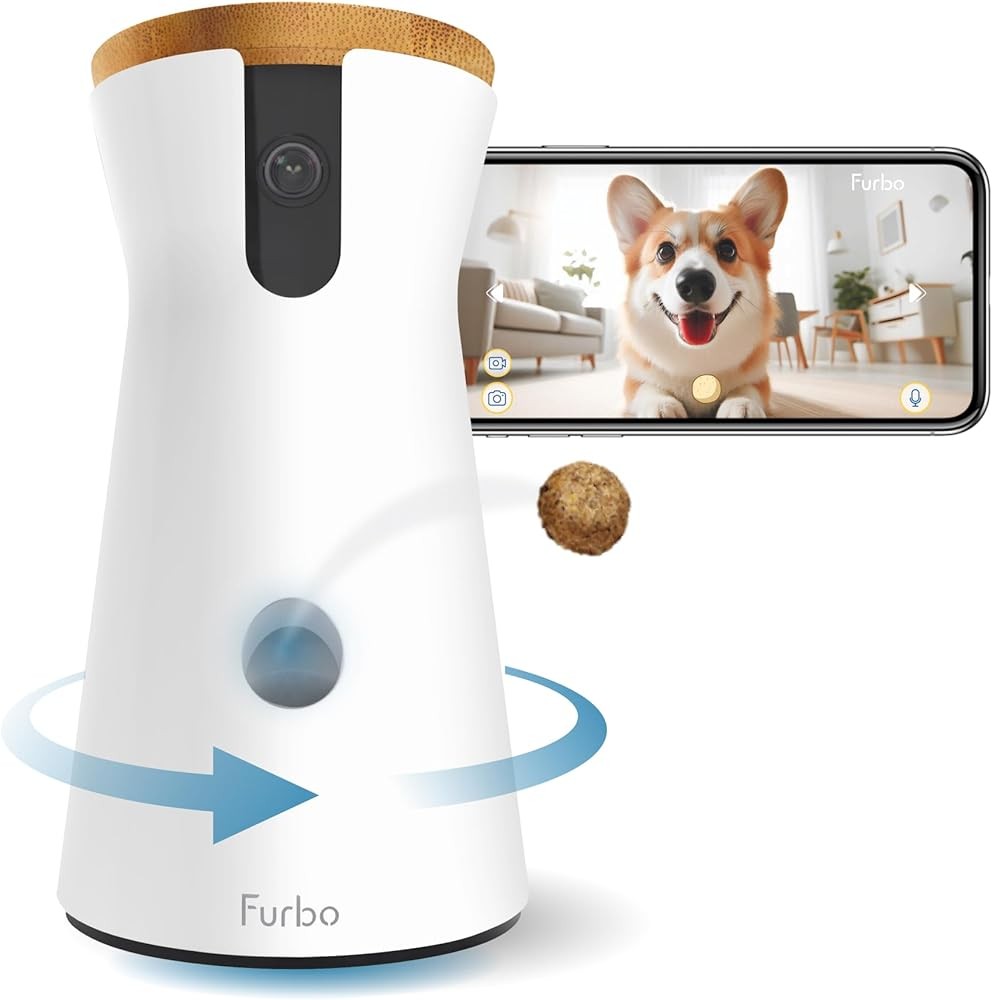
The Furbo 360 (no subscription) represents the premium option for owners seeking complete monitoring capabilities without ongoing service costs. The rotating camera head provides 360-degree coverage, eliminating blind spots common with fixed-position cameras.
Video quality reaches 1080p HD resolution with night vision capability for round-the-clock monitoring. The dual-functionality supports behavior observation during daytime activity and overnight rest periods. Image clarity allows owners to distinguish specific postures and movements associated with different emotional states.
Two-way audio includes both monitoring and communication functions. The integrated speaker delivers owner voices clearly enough for dogs to recognize familiar tones. Research demonstrates that familiar auditory cues can reduce stress responses in some dogs, though individual variation exists (PMID: 36146109).
The treat dispensing system tosses small kibble or training treats approximately 8-10 feet, encouraging movement and creating positive associations with camera interaction. This active engagement differs from passive monitoring, providing enrichment opportunities during owner absences.
Bark alert notifications use sound pattern recognition to identify canine vocalizations specifically. The system sends smartphone alerts when barking occurs, enabling owners to check video and assess context. This feature proves particularly valuable for dogs showing anxiety-related vocalization, allowing owners to identify triggers and patterns.
The no-subscription model provides full functionality without monthly fees. Cloud storage options exist for owners wanting extended video recording, but core features - live streaming, two-way audio, treat tossing, and alerts - operate without service plans.
Setup requires smartphone app download, WiFi connection, and positioning within treat-tossing range of the dog’s typical locations. The magnetic base allows flexible placement on flat surfaces or wall mounting for secure installation.
How to Use Dog Cameras for Anxiety Management
Monitoring technology provides tools, but effective use requires understanding of canine behavior and systematic observation approaches. Research-based strategies maximize the benefits of camera systems for managing separation-related behaviors.
Establishing Baseline Behavior Patterns
Effective monitoring begins with documenting normal behavior before implementing interventions. Video recording over several days reveals typical activity patterns, rest periods, and environmental responses.
Systematic observation includes:
- Duration to settling - Time from departure until dog stops active vigilance
- Activity levels - Frequency of movement versus resting throughout absence
- Vocalization patterns - When barking occurs, duration, and intensity
- Engagement with environment - Interaction with toys, beds, or other resources
- Response to stimuli - Reactions to outdoor noises, delivery personnel, or neighbors
Research examining behavioral monitoring systems found that multi-day observation periods provided sufficient data to identify consistent patterns versus isolated incidents (PMID: 35214457). This baseline documentation creates comparison points for assessing intervention effectiveness.
Identifying Specific Triggers
Many separation-related behaviors respond to identifiable triggers rather than generalized anxiety. Camera systems reveal environmental factors that precede stress responses.
Common triggers include:
- Departure cues - Keys, shoes, coat-taking that signal imminent leaving
- Time-based patterns - Anxiety increasing after specific durations alone
- External stimuli - Delivery trucks, mail carriers, neighborhood dogs
- Visual triggers - Movement outside windows, passing people or animals
- Auditory stimuli - Door sounds, vehicle noises, environmental alarms
Video documentation showing exact timing of behavioral changes relative to environmental events helps owners identify specific triggers. This information guides interventions targeting particular anxiety sources rather than applying general management strategies.
Studies of behavioral pattern recognition demonstrate that identifying temporal relationships between stimuli and responses provides valuable diagnostic information (PMID: 40516380). While this research examined algorithmic detection, the principle applies to owner observation through camera systems.
Implementing Remote Interaction Protocols
Two-way audio and treat dispensing enable active intervention during monitored absences. Strategic use of these features can support anxiety management, though effectiveness varies by individual dog.
Research-informed approaches include:
Scheduled check-ins - Brief voice contact at predetermined intervals rather than continuous monitoring. Studies suggest that predictable patterns may reduce vigilance behavior in some dogs, though research specifically examining this application remains limited.
Calm reinforcement - Treat dispensing when dogs display relaxed behavior encourages repetition of desired states. Positive reinforcement principles support rewarding calm rather than inadvertently reinforcing anxiety vocalizations with attention.
Distraction during triggers - Using treat toss or voice contact when external stimuli occur provides alternative focus. This approach requires real-time monitoring to catch triggering events.
Individual variation means that remote interaction benefits some dogs while potentially increasing arousal in others. Systematic observation of responses to different interaction patterns helps owners determine effective approaches for their specific dog.
The Furbo Mini 360 delivers core monitoring features in a more compact package, appealing to owners with space constraints or preferring less conspicuous equipment. The smaller housing maintains 360-degree rotation capability while occupying less surface area.
Video performance matches the full-size model at 1080p HD resolution with night vision. Image quality supports detailed behavior observation across standard room distances. The rotating function provides complete coverage despite the reduced physical size.
Treat dispensing operates through a similar tossing mechanism, though the compact design slightly reduces projection distance compared to larger models. Most dogs adapt to shorter throw distances, particularly when positioned strategically in main living areas.
The integrated speaker handles two-way audio communication, allowing owners to speak to dogs and hear vocalizations. Audio volume reaches levels sufficient for most environments, though larger rooms or background noise may affect clarity.
Bark detection and smartphone notifications function identically to premium models. The system identifies canine vocalizations and sends real-time alerts, enabling owners to check video and assess behavioral context.
At $99, the Mini 360 positions between budget subscription models and premium no-subscription options. This mid-range pricing provides full rotating coverage and treat dispensing for owners prioritizing value.
Setup follows standard smartphone app pairing with WiFi network connection. The compact base includes multiple positioning options for flat surfaces or shelf placement. Strategic location selection maximizes treat toss coverage while maintaining clear video angles.
Comparing Subscription vs. Subscription-Free Models
Dog camera manufacturers offer different service models affecting long-term costs and feature access. Understanding the trade-offs between upfront pricing and ongoing fees helps owners select appropriate options.
No-Subscription Benefits
Models providing full functionality without monthly fees appeal to owners preferring predictable one-time costs. The Furbo 360 (no subscription) and Furbo Mini 360 deliver core features - live video, two-way audio, treat dispensing, and alerts - without service plans.
Benefits include:
- Predictable costs - Single purchase price without accumulating monthly charges
- Full feature access - Core monitoring capabilities available immediately
- Long-term value - No ongoing fees over multi-year camera lifespan
- Privacy considerations - Limited cloud storage reduces data retention by third parties
- Simplified budgeting - One-time expense rather than recurring billing
The primary limitation involves video storage. No-subscription models typically provide limited cloud recording, requiring smartphone recording or local storage for preserving specific behavioral observations.
Subscription Model Features
Service-plan cameras like the Furbo 360 (subscription) reduce upfront costs but add monthly fees. The $48 initial price represents significant savings versus $99-164 alternatives, but accumulating subscription charges exceed that difference within 1-2 years of use.
Subscription features often include:
- Extended cloud storage - Days or weeks of video recording versus hours
- AI behavior analysis - Algorithmic detection of specific activities or patterns
- Emergency services - Veterinary consultation or monitoring integration
- Advanced alerts - Person detection, crying analysis, or detailed activity summaries
- Priority support - Faster customer service response for technical issues
Value assessment requires calculating total ownership cost over expected camera lifespan. A camera used for 3-5 years accumulates $180-300 in subscription fees at $5/month, or $540-900 at $15/month for premium plans.
Feature Comparison for Anxiety Management
Core anxiety monitoring needs - observing behavior, identifying triggers, remote interaction - function identically across subscription models. Live video streaming, two-way audio, and treat dispensing operate without service plans.
Advanced AI features in subscription tiers may provide automated behavior summaries or pattern detection. Research on algorithmic behavioral analysis shows promise for identifying specific postures and activities (PMID: 40516380), though most current consumer applications focus on general activity tracking rather than clinically-validated anxiety assessment.
Owners requiring basic monitoring to understand home-alone behavior typically find no-subscription models sufficient. Those wanting extended video review periods, automated analysis, or emergency service access may value subscription features despite higher long-term costs.
The subscription-based Furbo 360 reduces the initial financial barrier for owners wanting complete monitoring capabilities. The $48 entry price provides access to 360-degree rotating coverage, HD video, and treat dispensing with service plan activation.
Core hardware matches no-subscription models: 1080p video resolution, night vision, rotating camera head, treat tossing mechanism, and bark detection. Physical functionality operates identically across Furbo variants, with differences appearing in software features and cloud services.
The required subscription unlocks extended cloud recording, allowing review of hours or days of video rather than just live streaming. This storage capacity supports owners wanting to analyze behavior patterns across multiple absences without manually recording sessions.
AI-enhanced features in premium subscription tiers include person detection, activity summaries, and behavioral pattern analysis. These automated insights reduce manual video review time, though algorithmic accuracy varies and may not replace owner observation for detailed anxiety assessment.
Emergency veterinary consultation services connect owners with licensed professionals through some subscription plans. This feature provides rapid access to advice when camera monitoring reveals concerning behaviors, though it supplements rather than replaces in-person veterinary care.
Total cost calculation requires projecting camera lifespan and monthly fees. At typical $5-15/month subscription rates, a camera used for three years accumulates $180-540 in service charges beyond the initial purchase price. Owners planning long-term monitoring should compare this total against no-subscription models costing $99-164 once.
Setup matches other Furbo models with smartphone app pairing and WiFi connection. Subscription activation occurs through the app with payment information and plan selection.
Installing and Positioning Your Dog Camera
Effective monitoring requires strategic camera placement considering coverage area, WiFi signal strength, and treat-tossing range. Research-informed positioning maximizes behavioral observation while minimizing technical issues.
Optimal Location Selection
Camera position affects both visual coverage and interactive feature effectiveness. Ideal placement balances several factors:
Central positioning - Locating cameras in main living areas where dogs spend the most time ensures behavior observation rather than monitoring empty rooms. Studies examining home-alone behavior indicate that dogs typically remain in familiar spaces near owner scent and comfort items rather than exploring the entire house (PMID: 35214457).
Height considerations - Elevated positions between 4-6 feet provide optimal viewing angles for observing floor-level activity while remaining beyond reach of jumping dogs. Wall mounting or high shelf placement prevents anxious dogs from damaging equipment during stress responses.
Line-of-sight coverage - 360-degree cameras require fewer obstructions than fixed-position models, but furniture arrangement still affects visibility. Positioning with clear sight lines to beds, favorite resting spots, and primary activity areas improves behavioral documentation.
WiFi signal strength - Cameras require strong internet connections for reliable streaming. Testing signal strength at proposed locations before permanent installation prevents connectivity issues. Most smartphones include WiFi analyzer apps showing signal power at specific positions.
Treat Toss Range Optimization
Interactive dispensing features require dogs to be within mechanical range for effective treat delivery. Most tossing systems project treats 6-10 feet from the camera body.
Strategic positioning includes:
- Central room placement - Positioning cameras in middle zones rather than corners increases coverage area for treat landing
- Open floor space - Ensuring cleared areas around cameras prevents treats landing under furniture where dogs can’t retrieve them
- Multiple interaction zones - Aiming toss range to overlap with beds, play areas, or common resting spots
- Surface considerations - Tile and hardwood allow treats to slide further, while carpet reduces travel distance
Testing treat toss range before permanent installation helps identify optimal positions. Deploying several treats while observing landing locations reveals effective coverage areas.
Power and Connectivity Requirements
Most dog cameras require continuous power through AC adapters rather than battery operation. This dependency affects placement options near electrical outlets.
Extension cords or power strips enable more flexible positioning but introduce potential hazards. Anxious dogs displaying destructive chewing behaviors may damage exposed cords. Cable management solutions that conceal or protect power cables reduce this risk.
WiFi connectivity requirements vary by camera model. Systems supporting 2.4GHz networks typically provide better range and wall penetration than 5GHz-only models, though 5GHz offers faster data transfer when signal strength permits.
Network bandwidth affects video quality and streaming reliability. Homes with multiple connected devices or slower internet speeds may experience reduced performance during peak usage. Many camera systems allow adjusting video quality settings to match available bandwidth.
Privacy and Security Considerations
Internet-connected cameras introduce data security and privacy concerns requiring informed decision-making. Understanding how monitoring systems handle video data helps owners make appropriate choices.
Video Data Storage and Transmission
Camera systems store and transmit video through different architectures affecting privacy and security:
Cloud storage - Video uploads to manufacturer servers enabling access from anywhere. This convenience creates data custody questions about who controls recordings, retention periods, and third-party access.
Local storage - Some systems support microSD cards or network-attached storage keeping video within owner control. This approach provides greater privacy but limits remote access capabilities.
Encrypted transmission - Quality cameras encrypt video during internet transmission preventing interception. Verification of encryption protocols in product specifications confirms this protection.
Authentication requirements - Strong password protection and two-factor authentication options prevent unauthorized access to camera feeds.
Manufacturer Data Policies
Reading privacy policies reveals how camera companies handle user data. Key considerations include:
- Video retention periods - How long companies store recordings on their servers
- Data sharing practices - Whether video or metadata shares with third parties
- AI analysis - If algorithmic processing occurs server-side using user video
- Account security - Protection measures against hacking or unauthorized access
- Deletion capabilities - Owner ability to remove stored video from cloud servers
Research examining IoT device security demonstrates varying practices across manufacturers, with some implementing strong protections while others show vulnerabilities. While specific studies on dog cameras remain limited, general IoT security principles apply.
Protecting Your Network
Connecting cameras to home networks creates potential entry points for security breaches if not properly configured:
Network segmentation - Placing IoT devices on separate WiFi networks from computers containing sensitive information limits breach scope if cameras become compromised.
Regular updates - Installing firmware updates when manufacturers release them patches known security vulnerabilities.
Strong authentication - Using complex unique passwords rather than default credentials prevents common attack vectors.
Monitoring access logs - Reviewing which devices connect to cameras identifies unauthorized access attempts.
Integration with Comprehensive Anxiety Management
Camera monitoring provides valuable information but functions most effectively as part of multi-faceted approaches addressing canine separation anxiety. Research demonstrates that combined interventions typically show better outcomes than single-strategy approaches.
Behavioral Modification Programs
Systematic desensitization and counterconditioning represent evidence-based behavioral interventions for separation anxiety. Camera systems support these programs by:
Documenting progress - Video recording shows whether behavior improves, plateaus, or worsens as training advances. Objective documentation supplements owner impressions with visual evidence.
Identifying threshold levels - Monitoring reveals the duration dogs remain calm when alone, helping owners design graduated exposure exercises just below anxiety threshold.
Verifying protocol adherence - Recording departure routines confirms owners follow systematic procedures rather than inadvertently creating new anxiety triggers.
Assessing independent relaxation - Cameras show whether dogs settle into calm resting behaviors during absences or maintain vigilant alertness throughout.
Research examining multi-level behavioral monitoring systems achieved 86% accuracy in identifying separation anxiety symptoms, suggesting that systematic observation provides reliable information for tracking intervention effectiveness (PMID: 35214457).
Environmental Enrichment Strategies
Providing mental and physical stimulation during owner absences can reduce anxiety-driven behaviors by offering alternative activities. Camera monitoring helps assess enrichment effectiveness.
Enrichment approaches include:
Food-dispensing toys - Puzzle feeders and treat-release toys engage problem-solving behaviors. Camera observation reveals whether dogs interact with these items or ignore them due to anxiety levels exceeding food motivation.
Background audio - Leaving television, radio, or music playing provides ambient sound. Monitoring shows whether these stimuli have calming effects or get ignored.
Window views - Access to visual stimulation through windows offers environmental engagement. Cameras reveal whether outdoor observations reduce or increase arousal depending on individual dogs.
Comfort items - Recently worn owner clothing provides familiar scent. Video documentation shows whether dogs seek these items when anxious or show no preference.
Studies examining animal behavior monitoring note that environmental factors significantly influence stress responses and activity patterns (PMID: 35188134). While this research didn’t specifically examine dogs, the principles apply to understanding how enrichment affects home-alone behavior.
Complementary Calming Supplements
Some owners combine monitoring with calming supplements to support anxious dogs. Camera systems help assess whether these interventions affect observable behaviors.
Common supplement ingredients with anxiety research include:
L-tryptophan - An amino acid precursor to serotonin. L-tryptophan supplementation may support calmer emotional states in some dogs. Camera monitoring reveals whether supplement timing correlates with behavior changes.
CBD - Cannabidiol products show variable results for dog anxiety depending on dosing and formulation. Video documentation provides objective assessment of behavioral responses beyond owner impressions.
Herbal blends - Products containing chamomile, valerian, or passionflower claim calming effects. Camera observation shows actual impact on home-alone behavior patterns.
Monitoring supplements through video documentation prevents reliance on potentially misleading cues. Dogs may appear calm when owners return due to excitement masking prior anxiety. Cameras reveal actual behavior throughout absences rather than just departure and arrival states.
Anxiety Vests and Pressure Garments
Anxiety vests applying gentle pressure claim calming effects based on deep touch pressure theories. Camera monitoring provides objective assessment of effectiveness.
Video observation reveals:
- Wearing compliance - Whether dogs leave vests on or remove them when alone
- Behavioral changes - If symptoms decrease, remain unchanged, or potentially increase
- Activity effects - Whether vests affect movement patterns or resting behavior
- Duration of effects - If any behavioral changes persist throughout absences or diminish over time
Individual variation means some dogs show positive responses to pressure garments while others experience no measurable benefit. Camera documentation prevents continuing ineffective interventions based on assumptions rather than evidence.
Activity and Health Monitoring
GPS collars with health tracking complement home cameras by monitoring activity levels, heart rate variability, and sleep patterns. Combined data provides comprehensive behavioral health pictures.
Integration approaches include:
- Comparing home-alone versus accompanied activity - Identifying whether separation significantly reduces movement or engagement
- Correlating physiological and behavioral data - Matching heart rate changes with observed behaviors during specific events
- Tracking intervention effects - Assessing whether management strategies affect both observable behavior and physiological markers
- Long-term pattern analysis - Identifying trends over weeks or months rather than individual days
Research demonstrates that continuous physiological monitoring combined with behavioral observation provides more complete assessment of animal welfare than either measure alone. While specific studies on combining dog cameras with fitness trackers remain limited, the multi-modal approach aligns with research principles.
Choosing the Right Camera for Your Situation
Selecting appropriate monitoring equipment requires matching features to specific needs, living situations, and dog behaviors. No single model suits all circumstances.
Assessment Questions
Systematic evaluation helps identify priorities:
What behaviors need monitoring? - Dogs showing primarily vocal anxiety require different features than those displaying destructive chewing or elimination accidents. Bark alerts serve vocalization monitoring, while wide-angle or rotating cameras better capture movement throughout rooms.
How many hours alone typically? - Dogs left briefly need less comprehensive systems than those alone 8+ hours daily. Longer absences increase value of treat dispensing for mid-day interaction.
Is real-time monitoring feasible? - Owners able to check cameras periodically during absences benefit from two-way audio and treat tossing. Those unable to monitor during work hours may prioritize recording capabilities over interactive features.
What’s the budget including long-term costs? - Calculating total ownership over 3-5 years reveals whether subscription models or higher upfront costs provide better value for individual situations.
What’s the home WiFi reliability? - Homes with strong consistent internet support HD streaming, while variable connections may require cameras with adaptive quality settings.
Are multiple rooms needed? - Single-room monitoring suits dogs confined to specific areas, while free-roaming dogs may benefit from multiple cameras or 360-degree models capturing larger spaces.
Feature Priority Ranking
Different situations emphasize different capabilities:
For vocal anxiety - Bark detection alerts, two-way audio, treat dispensing for quiet reinforcement. Video quality secondary to audio features.
For destructive behavior - Wide coverage area, HD video for detail, motion detection showing exact damage timing. Interactive features optional.
For general monitoring - Balanced features with good video, basic alerts, treat capability. Mid-range pricing with no subscription.
For training support - Treat dispensing, clear two-way audio, recording capability to review sessions. AI detection features potentially useful.
For limited budgets - Weighing lower upfront cost with subscriptions versus higher initial price without ongoing fees based on projected usage duration.
Space and Home Considerations
Physical environment affects camera requirements:
Small apartments - Fixed-position cameras may suffice. Compact models save space. WiFi generally strong throughout.
Multi-level homes - Multiple cameras or strategic single placement. Signal strength varies by floor and construction materials.
Large open spaces - 360-degree or wide-angle essential. Treat toss range matters more in larger rooms.
Crate-trained dogs - Focused camera positioning on specific area. Close-range features less important.
Free-roaming dogs - Comprehensive coverage needed. Higher-end models justified by monitoring requirements.
Troubleshooting Common Camera Issues
Even quality monitoring systems encounter technical problems. Understanding common issues and solutions prevents frustration and maximizes uptime.
Connectivity Problems
WiFi-dependent cameras experience periodic connection issues:
Intermittent disconnections - Check WiFi signal strength at camera location. Move router closer, add WiFi extenders, or reposition camera within better coverage areas.
Failed initial setup - Verify 2.4GHz network availability if camera doesn’t support 5GHz. Temporarily disable VPNs or firewall settings blocking device connections.
Slow streaming or lag - Reduce video quality settings in app. Check available bandwidth during peak usage. Consider upgrading internet speeds if multiple devices compete.
Complete connection loss - Power cycle both camera and router. Update camera firmware. Reset camera to factory settings and reconfigure if problems persist.
Video Quality Issues
Image clarity affects behavior observation effectiveness:
Blurry footage - Clean camera lens. Check focus settings if manually adjustable. Verify adequate lighting levels for non-night-vision mode.
Dark video - Confirm night vision activation in low-light conditions. Check infrared LED functionality. Increase lighting if night vision performs poorly.
Choppy or pixelated streaming - Reduce quality settings matching available bandwidth. Minimize other network usage during critical monitoring periods.
Wrong viewing angle - Adjust camera position or rotation settings. Verify mounting security if angle shifts unexpectedly.
Audio Problems
Two-way communication requires functional microphone and speaker:
Can’t hear dog - Increase microphone sensitivity in app settings. Check for physical obstructions blocking microphone. Verify microphone permissions enabled on smartphone.
Dog doesn’t respond to voice - Increase speaker volume. Speak clearly close to phone microphone. Test whether dog reacts to other sounds through camera confirming speaker function.
Echo or feedback - Lower volume levels. Ensure speaker phone disabled. Separate speaker and microphone distances.
No audio at all - Verify audio enabled in app and phone settings. Check mute settings. Restart both camera and app.
Treat Dispensing Malfunctions
Mechanical issues affect interactive features:
Treats won’t dispense - Clear any jammed treats from mechanism. Verify hopper contains appropriate treat size for dispenser design. Check dispenser isn’t physically blocked.
Weak or short toss - Refill hopper ensuring adequate treats loaded. Clean toss mechanism of accumulated debris. Verify treats meet size specifications.
Mechanism jams frequently - Use uniformly sized treats without irregular shapes. Avoid sticky or moist treats that clump. Clean dispenser mechanism weekly.
App says dispense but nothing happens - Check power connection. Restart camera. Update firmware. Contact manufacturer if mechanical failure suspected.
Research Behind Pet Monitoring Technology
Scientific investigation of animal behavior monitoring extends beyond commercial dog cameras to research applications examining stress, activity patterns, and emotional states. Understanding these foundations provides context for consumer technology capabilities.
Behavioral Recognition Systems
Studies developing automated behavior detection demonstrate increasing sophistication in identifying specific postures and activities. Research creating multi-level hierarchical systems recognized dog postures using wearable sensors, then processed these into atomic behaviors, and finally identified complex behavioral patterns associated with separation anxiety (PMID: 35214457).
The system achieved approximately 0.86 F1-score in detecting symptomatic behaviors, indicating high accuracy in distinguishing normal activity from anxiety-related patterns. This performance level suggests that algorithmic approaches can provide reliable behavioral assessment when properly designed and validated.
Another study developed affective recommendation systems predicting dog emotions and barking patterns from camera footage (PMID: 36146109). The research combined emotion recognition with bark detection, using weighted averages to improve prediction accuracy. While developed for research purposes, these technologies demonstrate the technical feasibility of automated behavioral analysis.
Real-Time Pose Estimation
Advanced computer vision research enables tracking animal movements and postures in real-time. One study developed cross-species pose estimation systems achieving processing speeds exceeding 1,000 frames per second on high-end GPUs while maintaining accuracy across different animal species (PMID: 40516380).
While consumer dog cameras don’t currently incorporate this level of sophisticated analysis, the research demonstrates technical possibilities for future developments. Real-time pose tracking could eventually enable cameras to automatically identify stress postures, pacing patterns, or other anxiety indicators without requiring continuous owner observation.
The technology’s applicability across species and environmental conditions suggests robustness appropriate for home monitoring scenarios with varying lighting, camera angles, and backgrounds. Research applications requiring precise behavioral quantification drive developments that eventually filter into consumer products.
Limitations of Current Consumer Systems
Despite advancing technology, important gaps exist between research-grade monitoring and consumer dog cameras:
Validation specificity - Research systems undergo rigorous testing for specific behaviors. Consumer cameras typically lack published validation data demonstrating accuracy for detecting particular anxiety symptoms.
Algorithm transparency - Proprietary AI features in commercial products rarely disclose detection methods, sensitivity, or specificity. Owners can’t assess reliability compared to research-validated approaches.
Individual variation - Dogs show diverse behavioral expressions of anxiety. Systems trained on average patterns may miss atypical presentations specific to individual dogs.
Context requirements - Automated detection accuracy depends on optimal positioning, lighting, and environmental conditions. Real-world home settings introduce variables affecting performance.
These limitations mean that current consumer cameras serve best as tools supporting owner observation rather than replacing informed behavioral assessment. Technology assists but doesn’t substitute for understanding individual dog patterns and working with veterinary professionals when anxiety significantly impacts welfare.
Frequently Asked Questions About Dog Cameras
How long can I leave my dog alone with just a camera?
Camera monitoring doesn’t affect appropriate alone time - it only documents behavior during existing absences. Most adult dogs tolerate 4-6 hours alone when properly acclimated, though individual variation exists based on age, health, training history, and anxiety levels. Puppies under 6 months require more frequent bathroom breaks regardless of monitoring. Cameras help owners understand whether their specific dog shows signs of distress at particular durations, guiding decisions about alone time limits, but monitoring technology doesn’t substitute for meeting dogs’ social, exercise, and elimination needs.
Will my dog get used to being watched and behave differently?
Dogs don’t recognize cameras as monitoring devices. Unlike humans who may modify behavior when aware of observation, dogs respond to cameras only if they produce sounds, dispense treats, or emit unfamiliar lights. A 2022 study examining pet monitoring found that dogs showed no behavioral differences between recorded and non-recorded periods when cameras operated silently (PMID: 36146109). However, dogs do learn associations with interactive features - they may position near cameras after learning that treat dispensing occurs, which represents normal learned behavior rather than altered response to observation.
Can cameras replace hiring dog sitters or daycare?
Cameras complement but don’t replace social interaction, exercise, or elimination opportunities. Monitoring reveals whether dogs need additional support but doesn’t provide the benefits of human presence or canine socialization. Dogs experiencing significant separation anxiety typically benefit from professional dog walkers, pet sitters, or daycare reducing alone time regardless of owner’s ability to watch remotely. Cameras help owners make informed decisions about whether their dog needs these services by documenting actual home-alone behavior rather than guessing based on arrival/departure observations.
What treat types work best in camera dispensers?
Small, dry, uniformly-sized treats between 0.5-1cm work most reliably in dispensing mechanisms. Standard kibble from your dog’s regular food works well and avoids adding excessive calories. Commercial training treats designed for consistent size perform reliably. Avoid sticky, moist, irregularly-shaped, or crumbly treats that jam mechanisms. Very hard treats may bounce unpredictably when tossed. Soft treats clump together causing jams. Testing your preferred treats in the dispenser before leaving dogs unattended prevents discovering malfunctions when you can’t physically fix them.
Do cameras work for separation anxiety in senior dogs?
Yes, cameras help monitor senior dogs though anxiety management may require additional considerations. Older dogs developing new separation behaviors may show cognitive dysfunction requiring veterinary assessment rather than just behavioral intervention. Cameras document specific symptoms - disorientation, pacing, vocalization patterns - helping veterinarians distinguish anxiety from cognitive decline. Senior dogs with vision or hearing loss may respond differently to camera audio or treat tossing. Monitoring also reveals whether mobility issues affect anxiety-related pacing or if physical discomfort contributes to restlessness when alone.
How do I know if remote treat tossing is helping or making anxiety worse?
Systematic observation comparing baseline behavior to post-intervention patterns reveals treat dispensing effectiveness. Record behavior for several days without remote interaction establishing baseline anxiety levels, duration, and intensity. Then implement scheduled treat tossing while continuing to record behavior. Compare recordings looking for: reduced vocalization frequency or duration, faster settling times, decreased pacing, increased calm resting behavior. If anxiety symptoms worsen, increase, or show no change after 1-2 weeks of consistent treat timing, the intervention may not suit your specific dog. Some dogs become more vigilant anticipating treats, increasing arousal rather than promoting calm.
Can multiple people access the same camera account?
Most dog camera apps support multiple user accounts accessing the same camera, allowing family members or pet sitters to monitor simultaneously. Setup procedures vary by manufacturer - some allow adding users through email invitations, others require sharing login credentials. Consider security implications when sharing access, particularly with temporary users like pet sitters. Some systems offer different permission levels - full access versus view-only - preventing unintended setting changes. Review your specific camera’s multi-user capabilities in the manual or manufacturer support documentation.
What happens if my WiFi goes down while I’m away?
Most cameras stop functioning when WiFi disconnects, losing live streaming, alerts, and interactive features. Some models include cellular backup using mobile data networks, though this requires separate service plans. Cameras with local storage on SD cards may continue recording even without internet, though you can’t access footage remotely until WiFi restores. Power outages affecting WiFi routers also disable cameras unless backup power supplies maintain network equipment. Consider home network reliability when choosing monitoring approaches - homes with frequent outages may benefit from cellular-enabled cameras or backup internet solutions.
Will my dog’s barking trigger the treat dispenser accidentally?
Bark detection and treat dispensing operate as separate functions in quality cameras. Bark alerts notify owners of vocalization but don’t automatically dispense treats unless specifically programmed. Some advanced systems allow creating automated responses - dispensing treats when cameras detect quiet periods rather than barking - but this requires deliberate configuration. Default settings separate detection from dispensing preventing inadvertent reinforcement of barking. Review your specific camera’s automation capabilities to understand whether accidental triggers could occur with your chosen settings.
How often should I interact through the camera to help anxiety?
Interaction frequency depends on your dog’s individual response patterns. Research on separation anxiety management suggests that unpredictable owner contact may increase vigilance as dogs anticipate interaction, potentially maintaining arousal rather than promoting calm (PMID: 35214457). Systematic desensitization approaches typically recommend minimal intervention during training, allowing dogs to learn self-soothing. However, specific evidence comparing different remote interaction frequencies remains limited. Start conservatively with 1-2 brief check-ins during longer absences, observing whether your dog settles faster or remains vigilant afterward. Reduce frequency if monitoring shows increased restlessness following interactions. Some dogs benefit from scheduled predictable contact while others do better with minimal disruption.
Making the Most of Your Dog Camera Investment
Monitoring technology provides valuable tools when used systematically as part of comprehensive approaches supporting canine behavioral health. Cameras work best when owners understand both capabilities and limitations.
Setting Realistic Expectations
Dog cameras document behavior but don’t directly modify anxiety or distress. They function as observation tools enabling informed decision-making rather than treatment interventions. Understanding this distinction prevents disappointment when monitoring alone doesn’t resolve separation problems.
Effective use includes:
Documentation over assumption - Replacing guesses about home-alone behavior with actual visual evidence Pattern identification - Recognizing triggers, durations, and intensities guiding intervention development Progress tracking - Objectively assessing whether management strategies produce measurable improvements Information sharing - Providing veterinarians or behavioral consultants with video showing specific symptoms
Research demonstrates that systematic behavioral monitoring improves assessment accuracy compared to owner recall alone (PMID: 35214457). Cameras excel at this documentation function when owners commit to regular observation and record-keeping.
Developing Observation Routines
Consistent monitoring patterns yield more useful information than sporadic checking:
Scheduled review periods - Watching footage at specific times reveals behavior during particular absence portions Comparative analysis - Reviewing multiple days identifies consistent patterns versus isolated incidents Trigger documentation - Noting environmental events preceding behavioral changes connects stimuli to responses Duration tracking - Recording how long symptoms persist helps assess severity and intervention needs
Creating simple logs noting date, duration of absence, observed behaviors, and environmental factors builds comprehensive pictures of individual dog patterns over time.
Coordinating with Professional Support
Veterinarians and certified behavioral consultants benefit from video documentation showing specific symptoms. Sharing footage helps professionals:
Diagnose conditions - Distinguishing separation anxiety from other behavioral or medical issues Assess severity - Evaluating whether symptoms require medication, behavior modification, or both Monitor progress - Reviewing footage over treatment courses shows objective improvement or need for strategy adjustment Provide targeted recommendations - Seeing actual home environments and dog responses enables specific rather than general advice
Most professionals welcome video documentation supplementing owner descriptions. Preparing brief clips showing representative behaviors saves consultation time and improves accuracy.
Balancing Monitoring with Other Interventions
Cameras complement rather than replace proven anxiety management approaches. Comprehensive programs typically include:
- Behavioral modification - Systematic desensitization and counterconditioning protocols
- Environmental management - Providing enrichment, comfort items, and appropriate space
- Exercise and engagement - Meeting physical and mental stimulation needs before absences
- Veterinary assessment - Ruling out medical contributors and considering medication when appropriate
- Professional training - Working with certified behaviorists for severe cases
Monitoring helps assess each intervention’s effectiveness, allowing evidence-based decisions about which strategies help individual dogs.
- Investigating Targeted and Untargeted Approaches to Biomarker Discovery in Fearful, Adult Dogs.. PubMed 42616905
- Genetic mapping of canine fear and aggression.. PubMed 27503363
- Investigating Targeted and Untargeted Approaches to Biomarker Discovery in Fearful, Adult Dogs.. PubMed 42616905
- Genetic mapping of canine fear and aggression.. PubMed 27503363
References
- A non-separation diagnostic framework for assessing canine attachment structure.. PubMed 42078843
- Professional perspectives on recurrent characteristics of dogs with separation-related problems: a qualitative study in three nordic countries.. PubMed 41565946
- Higher burden of neuropsychiatric symptom-like behaviors associated with canine cognitive dysfunction compared to normal aging in the Dog Aging Project.. PubMed 41526594
- A Pre-Screening Tool to Assess Dog Suitability for Animal-Assisted Interventions: Preliminary Results for Dog-Suitability Tests (SuiTe).. PubMed 41472091
- Preliminary Findings on Low-Dose 1cp-LSD for Canine Anxiety: Exploring the Role of Owner Neuroticism and Psychopathology.. PubMed 41012797
- Evaluating the Potential of Microdosing 1cp-LSD for the Treatment of Canine Anxiety: A One-Month Case Study.. PubMed 40638522
- Real-world data on behavioral practices for dogs in primary care veterinary hospitals in the United States (2010-2020).. PubMed 40107234
- The Puppies’ Age at Adoption Time Influences the Behavioral Responses of Adult Dog.. PubMed 40005936
Related Reading
- Best Dog Anxiety Vests and Calming Wraps - Pressure garment options for anxious dogs with camera monitoring to assess effectiveness
- CBD for Dog Anxiety and Aggression - Cannabidiol research and applications with monitoring to track behavioral responses
- Best Calming Supplements for Dogs with Separation Anxiety - Supplement ingredients supported by research with camera documentation of effects
- L-Tryptophan for Dog Anxiety and Stress Relief - Amino acid supplementation for anxious dogs with monitoring protocols
- Best GPS Dog Collars and Health Activity Trackers - Activity monitoring devices complementing camera systems for comprehensive behavioral health tracking
Bottom Line: Choosing Your Dog Monitoring System
Research-supported dog cameras provide valuable observation tools for understanding home-alone behavior, identifying anxiety triggers, and assessing intervention effectiveness. The Furbo 360 Dog Camera (no subscription) delivers comprehensive monitoring through rotating 360-degree coverage, HD video quality, two-way audio communication, treat dispensing interaction, and bark detection alerts without ongoing monthly fees, making it the premium choice for owners prioritizing complete functionality and long-term value at $164. Studies demonstrate that multi-modal monitoring systems combining visual observation with audio detection achieve 86% accuracy in identifying separation anxiety symptoms (PMID: 35214457), supporting cameras with integrated capabilities rather than single-function devices.
The Furbo Mini 360 provides excellent value for space-conscious owners, delivering full rotating coverage and core features including HD video, treat tossing, and bark alerts in a compact package at $99 without subscriptions. For budget-focused buyers, the Furbo 360 with subscription offers entry-level pricing at $48 though accumulating monthly fees eventually exceed no-subscription alternatives over multi-year ownership periods. Research on behavior recognition technology shows that real-time pose estimation and activity pattern detection continue advancing (PMID: 40516380), suggesting future consumer cameras may incorporate increasingly sophisticated automated analysis, though current models function best supporting informed owner observation rather than replacing behavioral assessment.
Effective use requires systematic documentation establishing baseline patterns, identifying specific triggers through temporal analysis, and coordinating camera observations with comprehensive anxiety management including behavioral modification, environmental enrichment, and veterinary consultation when symptoms significantly impact wellbeing. Monitoring technology documents whether interventions produce measurable improvements but doesn’t substitute for meeting dogs’ fundamental needs for social interaction, physical exercise, mental stimulation, and appropriate alone-time acclimation through gradual training protocols.
Recommended Products